Friday, December 27, 2019

Semi-trailer Market to Surpass US$ 24 Bn by 2026

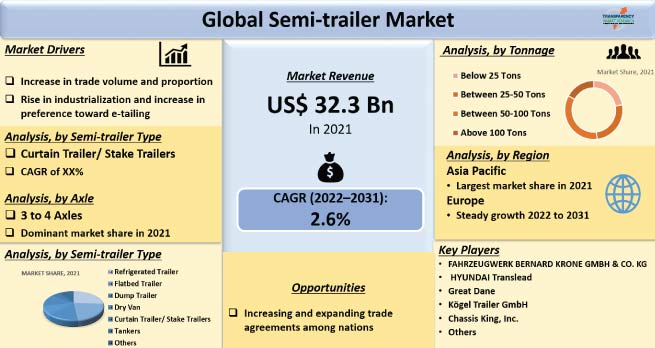
Transparency Market Research has published a new report titled, “Semi-trailer Market (Semi-trailer Type, Tonnage, Axle, End-use Industry, and Region) - Global Industry Analysis, Size, Share, Growth, Trends, and Forecast, 2018 – 2026”. According to the report, the global semi-trailer market is anticipated to surpass US$ 24 Bn by 2026, expanding at a CAGR of more than 3% during the forecast period.
The market for semi-trailers is anticipated to expand during the forecast period due to industrial expansion that leads to higher demand for semi-trailers in order to transport raw material and goods to end-users and suppliers. Amendment in trade policies fueled road transportation, which in turn is estimated to boost the semi-trailer market.
semi trailer market
Request Sample PDF With Strategic Insights @  - https://www.transparencymarketresearch.com/sample/sample.php?flag=B&rep_id=28718
Rising global population has significantly boosted the demand for consumer goods, thus significant expansion of agriculture and manufacturing industries fueled the demand for semi-trailers. Moreover, development of good road connectivity is propelling the market for semi-trailer. Cost-effectiveness of transportation by semi-trailers is a key factor driving the semi-trailer market owing to the high cargo-carrying capacity of the vehicle. Increased spending by governments in order to improve road connectivity is likely to drive the semi-trailer market during the forecast period. Such high investment for road connectivity development after the Second World War resulted in the development of significantly large road transportation and semi-trailer markets. Low speed of the semi-trailer and presence of smaller roads and sharp turns on roads are major factor restraining the semi-trailer market due to its large size and large turning radius. Massive backlog in proper maintenance of roads is also a major factor that is likely to hinder the demand for road freight transportation during the forecast period. Furthermore, toll roads or booths lead to considerable time loss, which results in slow transportation of freight. Poor road infrastructure coupled with a lack of intent to improve transport facilities is expected to restrain the demand for road freight transportation and consequently, hamper the semi-trailer market during the forecast period.
In terms of semi-trailer type, factors driving the expansion of each type of semi-trailer is different. For instance, products that need to be maintained at a specific temperature range are transported through refrigerant or reefer trailers, while different types of semi-trailers are utilized to transport pallets to different regions owing to their regulatory norms and weather dynamics. Moreover, dry vans are highly preferred for transport of cargos. Consequently, the dry van segment held a significant share of the global semi-trailer market owing to the high rate of adoption of dry vans in North America and Mexico.
Across regions, the market for semi-trailer varies largely in terms of semi-trailer type, tonnage, and axles. On a broader scale, in terms of revenue, North America held a prominent share of the global semi-trailer market, while in terms of volume, Asia Pacific dominated the semi-trailer market in 2017. High cost of semi-trailers in North America coupled with their high tonnage capacity led the region to hold a major share of the global market, in terms of revenue, despite holding a lower share of the global semi-trailer market, in terms of volume. In North America, dry vans are highly popular, which are more expensive than stake trailers that hold a notable share of the market in Asia Pacific.
Key manufacturers operating in the global semi-trailer market are China International Marine Containers (Group) Ltd., FAHRZEUGWERK BERNARD KRONE GMBH & CO. KG, Great Dane, HYUNDAI Translead, Kögel Trailer GmbH, Chassis King, Inc., LAMBERET SAS, Schmitz Cargobull, Schwarzmüller Group, Shandong Arima group, Shandong Liang Shan Huayu Group, Wabash National Corporation., Utility Trailer Manufacturing Company, Dorsey Trailer, MANAC INC., Polar Tank, and Fontaine Commercial Trailer, Inc. China International Marine Containers (Group) Ltd and Schmitz Cargobull are major manufacturers of semi-trailers, which contributed to a prominent share in the global semi-trailer market.

First and Last Mile Delivery Market to Reach US$ 1,100 Mn by 2026

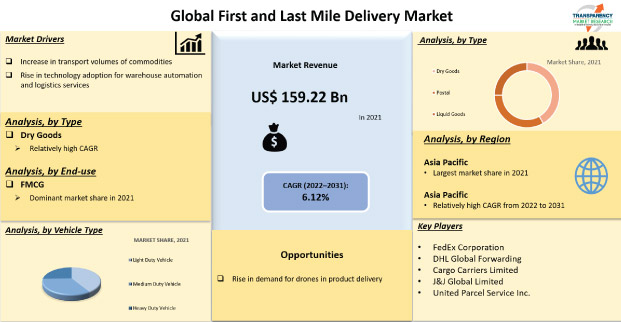
Transparency Market Research has published a new report titled, “First and Last Mile Delivery Market (Vehicle Type: Light Duty Vehicle, Medium Duty Vehicle, and Heavy Duty Vehicle; Cargo Type: Dry Goods, Postal, and Liquid Goods; End-use: Chemical, Pharmaceutical & Healthcare, FMCG, Hi-tech Product Industry, Food and Beverage, and Others) - Global Industry Analysis, Size, Share, Growth, Trends, and Forecast, 2018–2026.” According to the report, the global First and Last Mile Delivery Market is projected to surpass US$ 1,100 Mn by 2026, expanding at a CAGR of 14.77% during the forecast period.
According to the report, the global first and last mile delivery market is likely to be driven by a range of macroeconomic and industry-specific factors. Asia Pacific is expected to be at the forefront of global demand, with the market in the region expanding at a CAGR of 18.23% between 2018 and 2026.
first and last mile delivery market
Request Sample PDF With Strategic Insights @  - https://www.transparencymarketresearch.com/sample/sample.php?flag=S&rep_id=60984
The first and last mile delivery of product distribution is vital to any merchant. The first mile always indicates the movement of goods from retailer to courier service or anyone who supplies the goods to the end-user or final distributer, while last mile denotes the final stage of movement of goods to its final customers.
Supply chain management providers are adopting innovative and latest technologies in order to enhance their availability, elasticity, sustainability, and efficiency. Several customers are willing to pay additional or extra charge for delivery or for immediate delivery, which in turn is projected to fuel the demand for first and last mile delivery in the near future. Adoption of cyber physical system-based service and use of sophisticated and metaheuristic algorithms are boosting the productivity of fist and last mile delivery solutions. Digitization in supply chain, such as integration of major technologies such as smart logistics and warehousing, and critical analysis of information are anticipated to increase the demand for first and last mile delivery in different industries. This, in turn, is likely to propel the first and last mile delivery mile market during the forecast period. Furthermore, increase in urbanization which leads to a more concentrated consumer market, drastic change in consumer behavior, and increase in use of digital platforms for purchase are likely to propel the first and last mile delivery market during the forecast period.
In terms of vehicle type, the global first and last mile delivery market has been bifurcated into light duty vehicle, medium duty vehicle, and heavy duty vehicle. In terms of revenue, the light duty vehicle segment accounted for a major share of the market in 2017. Moreover, retail price, acceleration, fuel economy, interior volume, and ease of operation of light duty vehicles in urban areas prompts most logistic companies to prefer light duty vehicles. Road logistics and transportation activities are increasing across the globe. However, road transport contributes to significant share of carbon emission globally. Stringent emission norms and development of electric vehicles by OEMs are likely to boost the light duty vehicle segment during the forecast period.
In terms of end-use, the first and last mile delivery market has been segregated into chemicals, pharmaceutical & healthcare, FMCG, food and beverage, hi-tech product industry, and others. The FMCG segment is anticipated hold a major share of the market during the forecast period. Shift of preference of urban consumers from essential to premium products, attractive supply chain solutions provided by logistic companies, increase in accessibility of online stores, and expansion of e-commerce industry are projected to fuel the FMCG segment during the forecast period.

On-demand Transportation Market is Exceed US$ 350 Bn by 2026

Transparency Market Research has released a new market report titled “On-demand Transportation Market (Type: Ride Sharing, Vehicle Leasing/Rental, and Ride Sourcing; Business Model: P2P, B2B, and B2C; Vehicle Type: Passenger Cars, LCVs, HCVs, Buses & Coaches, and Micro-mobility; Autonomy Level: Manual, Semi-Autonomous, and Autonomous; Power Source: Fuel Powered, HEV, PHEV, and BEV; Application: Passenger Transportation and Goods Transportation, and Region: North America, Europe, Asia Pacific, Latin America, and Middle East & Africa) – Global Industry Analysis, Size, Share, Growth, Trends, and Forecast, 2018–2026.” According to the report, the global on-demand transportation market is expected to expand at a CAGR of about 14% during the forecast period.
on demand transportation market
Request Sample PDF With Strategic Insights @  - https://www.transparencymarketresearch.com/sample/sample.php?flag=B&rep_id=55536
The transportation industry is undergoing significant transformation and people are adopting online booking applications in order to book a mode or means of transportation. Rising traffic congestion and high fuel cost are key factors driving the adoption of on-demand transportation services. Adoption of smartphone-based internet services is rising among consumers, primarily due to the increased usage of smartphones, ease of operating the app, faster internet connectivity, and presence of globally leading and local service providers coupled with lower charges of services. High cost of vehicle ownership is encouraging people to prefer on-demand transportation services owing to their cost effectiveness and availability as per the requirement. Furthermore, on-demand transportation is an effective solution for the rising traffic congestion, as higher vehicle ownership is likely to boost the number of vehicles on road. Less number of vehicles per 100 people, increase in number of daily commuters heading to workplaces and homes, increased burden on public transportation facilities due to rapid urbanization, and lack of proper connectivity of public transportation systems are fueling the demand for on-demand transportation services. On the other hand, public transportation facilities across the globe are failing to cater to the demand, due to increasing urbanization and rising population. Increase in number of working class people, rise in income opportunities, increase in per capita income coupled with increased tendency to travel for work and holidays are fueling the demand for on-demand transportation services across the globe.
Countries from Europe and North America are well-developed and witness extensive adoption of advanced technologies and smartphones. Availability of faster internet connectivity and presence of globally leading service providers coupled with higher rate of adoption from consumers led the organized sector to hold a major share of the market in North America and Europe. However, in other regions, the unorganized segment accounts for major share of the market, in terms of revenue. Vehicles utilized in the unorganized sector are generally privately owned. These are considered as private services, as unorganized services cannot be availed through internet or smartphone-based apps.
In terms of type, ride sourcing is an emerging trend across the globe, in which consumers can book a ride via a smartphone-based app. Ease of operating the app, increased penetration of smartphone users, and availability of reliable internet services are fueling the demand for ride sourcing services. Ride sourcing services are flexible and hence, a large number of consumers traveling to workplaces, homes, to restaurants, and colleges prefer ride sourcing services. Thus, the demand for ride sourcing services is increasing owing to an increase in the working class population. Low rate of motorization, lack of adequate public transportation facility, crowded public transportation, and increase in fuel prices coupled with elimination of driving are fueling the ride sourcing segment of the global on-demand transportation market. The ride sourcing segment of the market is anticipated to expand at a CAGR of about 20% during the forecast period.

Server Microprocessor Market Scope, Trends, Future Demand 2027

A microprocessor is a single chip that integrates the functions of the central processing unit of a computer. The microprocessor consists of functions such as data storage, logical functions, timing functions and interaction with the peripheral devices. The server processor is one of the major component of the server, that handles all the tasks or instruction assigned to it. Due to the demanding applications, the processor performance is an important parameter in its specifications. With the development of the advanced technology the microprocessor has evolved through a series of innovations, with respect to clock rate, operating frequency, storage capacity, increased number of transistors and registers. The server processors are designed to handle heavy workloads for the IT companies from data centers and server rooms to the cloud providers. The server microprocessors are capable of providing multitasking performance for virtual environment. Server Microprocessors are designed in such a way that they can be operated at higher frequencies and can process data in memory and other sub systems. They are capable of overcoming any failure in case of shutdown or crash.
Server microprocessor contains more powerful processors as compared to the desktop computer. Also server microprocessors support multiple cores, multiple threads and multiple processors, to maintain its performance level. Server microprocessors have huge storage capacity with the facility to insert multiple disk into it. These disks are configured to look as a single disk to a user. Server microprocessor offers advanced storage interconnection technologies such as serial attached SCSI (SAS) providing higher performance over to SATA, a primary storage device in desktop computers. The major factors that drives the server microprocessor market are growing IT industries demanding cloud based and web based services and increasing data centers. The need to make compact devices or processors has given rise to the server microprocessor market. The major factor that restraints the growth of the server microprocessor market is the high cost involved. Faster the processor speed greater is the cost involved in it. However, due to the advantages of server processor over normal desktop processor, the server processors are more preferred depending on the applications. Increasing trends in the internet of things (IoT’s) is expected to offer more opportunities for the server microprocessor market.
Request Sample PDF With Strategic Insights @  https://www.transparencymarketresearch.com/sample/sample.php?flag=S&rep_id=40109
The server microprocessor market can be segmented into design, number of cores, end user, and geography. On the basis of design, the server microprocessor market is segmented into X86 and advanced RISC machines. Based on core numbers, the global server microprocessor is further segmented into less than six Cores and more than six cores. Based on the end use, the server microprocessor market is segmented into small, medium and large enterprise. The global server microprocessor market is also segmented on the basis of regions into North America, South America, Europe, Asia Pacific, and Middle East & Africa.  The global server microprocessor market is dominated by the Asia Pacific, owing to the large presence of semiconductor companies, followed by the North America.
As per the analysis, major international players are present in Server Microprocessor Market are Advanced Micro Devices (AMD), Inc., Hisilicon Technologies Co. Ltd., Cavium Inc., Intel Corporation, Toshiba Corporation, Baikal Electronics Jsc, Texas Instruments Incorporated, Qualcomm technologies Inc., International Business Machines Corporation, and Arm Limited among others. The most widely used server microprocessors are of Intel corporations and Advanced Micro Devices Inc. Intel provides a wide range of server microprocessors followed by Advanced Micro Devices.

Pan-tilt-zoom (PTZ) Camera Market Share, Growth, Size, Trends, Shipment, Sales | Industry Forecast 2026

A pan-tilt-zoom (PTZ) camera is an Internet Protocol (IP) type camera where the operator can easily control the position and movement of the camera lens from a remote position, using controls on software application and an Internet browser from anywhere in the world. The optical zoom feature provides the capability to focus on fine details such as license plates and faces. These cameras contain built-in true auto focus and event management systems. The PTZ camera can be mounted onto a flat surface using the supplied mounting hardware. Moreover, these cameras are utilized in a wide range of video surveillance applications across the globe. The PTZ camera market is anticipated to expand at a steady pace during the forecast period.
The pan-tilt-zoom (PTZ) camera market can be segmented based on type, application, end-use, and geography. Based on type, the pan-tilt-zoom (PTZ) camera market can be segregated into indoor pan-tilt-zoom (PTZ) camera and outdoor pan-tilt-zoom (PTZ) camera. The outdoor pan-tilt-zoom (PTZ) camera segment is expected to expand at a high CAGR during the forecast period. In terms of application, the global pan-tilt-zoom (PTZ) camera market can be classified into residential, commercial, and industrial. Commercial and residential segments held a major share of the global pan-tilt-zoom (PTZ) camera market in 2017 and projected to gain market share in the near future. Furthermore, based on end-use, the global pan-tilt-zoom (PTZ) camera market can be segregated into transportation, aerospace, military & defense, automation, research and institute, others. The military & defense segment is anticipated to expand at a high CAGR during the forecast period. It is also a highly attractive segment for the manufacturers of pan-tilt-zoom (PTZ) cameras.
Request Sample PDF With Strategic Insights @  https://www.transparencymarketresearch.com/sample/sample.php?flag=S&rep_id=40100
Additionally, the usage of wireless IP-based video surveillance and rising trend of VSAAS services are expected to propel the demand for PTZ cameras in the near future. This, in turn, is expected to create new opportunity for the global pan-tilt-zoom (PTZ) camera market during the forecast period. Across the globe, increasing awareness about safety and security across different end-use industries is driving the pan-tilt-zoom (PTZ) camera market. However, the need for high capacity storage for high-resolution images is likely to restrain the pan-tilt-zoom (PTZ) camera market in the near future. Moreover, the need for higher bandwidth to transfer data is a major challenge for the pan-tilt-zoom (PTZ) camera market.
The global market for pan-tilt-zoom (PTZ) cameras has been expanding significantly owing to rapid industrialization. Increasing implementation of stringent regulations and rules for different workplace security by various governments is also propelling the propelling the PTZ market to a great extent. Based on geography, in terms of revenue and volume, the pan-tilt-zoom (PTZ) camera market can be segregated into North America, Europe, Asia Pacific, Middle East & Africa (MEA), and South America. Asia Pacific accounted for a significant share of the global pan-tilt-zoom (PTZ) camera market in 2017. Within Asia Pacific, China and India hold a major share of the market due to increasing awareness about the rising application of pan-tilt-zoom (PTZ) camera in different end-use industries such as transportation and military & defense. Additionally, rising demand from the automotive industry is also driving the global pan-tilt-zoom (PTZ) camera market. Moreover, advancement of border security monitoring equipment is likely to drive the market in the near future. Furthermore, early adoption of new advanced technologies such as wireless connectivity, megapixel cameras, and integrated analytics for transportation monitoring have led to the increase in adoption and installation of pan-tilt-zoom (PTZ) cameras across various sub-regions of Asia Pacific. The pan-tilt-zoom (PTZ) camera market in North America is projected to expand at a prominent CAGR during the forecast period, followed by Europe.
The pan-tilt-zoom (PTZ) camera market is characterized by the existence of numerous key players in the market. Key companies operating in the market include Panasonic Corporation (Japan), Axis Communications AB (Sweden), Netgear (the U.S.), Pelco(U.S.), Zhejiang Dahua Technology Co., Ltd. (China), Honeywell Security Group (the U.S.), Infinova Corporation (the U.S.), Nest Cam (the U.S.), Amcrest Technologies (the U.S), and Icontrol Networks (the U.S.).

PC Processor Market Share, Growth, Size, Trends, Shipment, Sales | Industry Forecast 2026

A processor is also commonly known as microprocessor. It is chip mounted on the motherboard of the computer. This chip is a vital component of the personal computer (PC) along with RAM, memory, and connectors for input and output devices. The PC processor responds to input and processes the instruction that is used to drive the computer. The main functions of the processor are to fetch, decode, execute, and write back. A processor consist of processor registers, arithmetic logic unit, and a control unit. Processors are commonly referred to as Central Processing Unit (CPU) and they are installed in all PCs. However, there are many other processors too that are independently or simultaneously installed on the mother board. These processors perform their operations on some external data source, usually memory. Earlier, PCs primarily consisted of only the CPU. However, in the future, computers are likely to possess hybrid systems i.e multi-core CPUs with parallel core Graphics Processing Units (GPU).  CPUs are very flexible as compared to other devices when it comes to software programs running on them and are used for general purpose work. GPUs have much better graphical interfaces and are used for high-end gaming, designing, visualization, animation, and other applications that require high-end graphics. Field-programmable gate arrays processors are gaining popularity as they are suitable for industrial, medical, and military devices. Renowned players as well as startups are aggressively developing the processors for artificial intelligence driven practical applications. Each type of processor has its own advantages and disadvantages.
The PC processor market is primarily driven by increased availability of data and improved algorithms over the last few years. PC processors have a number of uses in medical imaging, CAD & CAE, animation modelling and rendering, computation, and design and visualization. Increase in IoT adoption is expected to help connect billions of new devices, which would require more computing efficiencies and speed. Furthermore, integrations of FPGAs and CPUs for high performance supercomputing or computing applications is anticipated to fuel the PC processor market in the near future. However, any new technological development in IC or other semiconductor devices can disrupt the PC processor market.
Request Sample PDF With Strategic Insights @  https://www.transparencymarketresearch.com/sample/sample.php?flag=S&rep_id=40097
The PC processor market can be segmented based on type, application, and end-user. In terms of type, the PC processor market can be classified into central processing unit (CPU), graphics processing unit (GPU), field programmable gate array (FPGA), and others. Currently, CPU is most commonly used and known processor. However, GPUs are expected to overtake CPUs in future due to their ability to provide deep learning, high-end gaming, engineering applications, analytics, etc. In terms of application, the PC processor market can be divided into computational finance; climate, weather, and ocean modelling; defense and intelligence; medical and entertainment; medical imaging; research; and others. Based on end-user, the PC processor market can be segregated into consumer electronics, automotive, industrial, health care, aerospace & defense and others. PC processors are extensively used in consumer electronics, industrial, and health care sectors.
In terms of geography, the PC processor market can be segmented into North America, Europe, Middle East & Africa, Asia Pacific, and South America. North America is expected to dominate the PC Processor market due to the presence of a large number of PC manufacturing companies in the region.
Prominent players in the PC processor market include Intel Corporation, Advanced Micro Devices, NVIDIA Corporation, Graphcore Ltd, Xilinx Inc., TeraDeep Inc., Qualcomm Incorporated, and Alphabet Inc. Intel Corporation and Advanced Micro Devices CPUs are most famous and widely used. These major companies are continuously investing in research and development activities in order to modernize the existing processors. They are also focusing on developing new advanced processor systems that are able to compute complex applications.

Thursday, December 26, 2019

Refrigerated Counter Market to reach US$8.7 bn by 2024

The vendor landscape of the global refrigerated counter market features an intensely competitive nature, with the leading five companies collectively accounting for over 62% of the market and the rest of the market consisting of a large number of medium- and small-scale players, observes Transparency Market Research in a recent report. With the aim of strengthening their positions, leading players are focusing on expanding their product portfolios, consumer bases, and geographical territories via divestments, mergers, and acquisition.
Transparency Market Research, in one of its recent report, states that the global refrigerated counter market will clock in a promising 8.4% CAGR over the period between 2016 and 2024 in terms of volume. The market is expected to register a 7.7% CAGR over the said period and rise from a valuation of US$4.5 bn in 2015 to US$8.7 bn by 2024.
Request Sample PDF With Strategic Insights @  https://www.transparencymarketresearch.com/sample/sample.php?flag=S&rep_id=15161
refrigerated counter market
Quick Service Restaurants to Help Market Procure Much of its Revenue
Of the key end-use areas for refrigerated counters, the segment of system catering accounted for a massive 80.9% of the overall market in 2016. Within the segment, quick service restaurants are likely to contribute the dominant share to the global refrigerated counter market over the report’s forecast period. The massive rise in a number of world-leading quick service restaurants across emerging economies and expansion of chain in homelands has benefitted the market for refrigerated counters in the recent past and will continue to be a key force driving the market towards a healthy growth path in the near future as well.
From a geographical standpoint, the report states that the market for refrigerated counters in regions such as Asia Pacific and North America will continue to be highly promising. While the market in North America will retain its leading stance in terms of the top contributor of revenue to the global market, the market in Asia Pacific will emerge as the most lucrative one, with an impressive 10.1% CAGR over 2016 and 2024.
Growth of Fast Food Chains Globally to Help Market Expand
One of the key factors expected to boost the global sales of refrigerated counters includes the tightening grip of regulatory bodies on the food production, processing, and transportation industries. So as to bring down the prevalence of food-borne diseases, food safety organizations in several countries have introduced stringent norms for food preparation and storage, which also includes the use of refrigerated counters to keep food at low temperatures thus mitigating the possibility of production of microbes in the food products.
The market is also likely to massively benefit from the rapid expansion of several international food chains across the globe. As most food chains require a variety of refrigerates equipment to keep food products sourced in bulk safe for consumption for longer durations, the rising numbers of food chains will prove to be a key driver for the market in the next few years. However, the high base cost and total cost of operation of high-end refrigerated counters could act as a restraint for the market, reining in its growth prospects to a certain extent.

tech