Friday, December 27, 2019

Online Home Decor Market Size, Share, Trends, Growth, Export Value, Volume

A broad range of products are sold through the online retail market. Based on the professional model of global online retail vendors, the product types can be segmented into several key segments. These include consumer electronics, footwear, apparel, and accessories, music, books, food and grocery, home care products, home décor, and other products. Out of these, home decor goods are those that enhance the visual appeal of the house which comprise posters, paintings, frames, decorative stickers, furniture, vases, wall mirrors, and many more. Some players in the online home decor market provide hassle-free home delivery selection to customers.
Increasing demand for eco-friendly furnishings, growing popularity of interior designing, and rising demand for multifunctional furniture are the major trends which are estimated to drive the demand for online home decor during the forecast period. Furthermore, rising demand for premium furniture is the key driver estimated to expand the overall online home decor market in the near future. This is due to individuals opting for luxury furniture brands as the buying power is increasing with economic growth, thus increasing the importance of home decor. However, increase in operational cost is expected to restrain the online home decor market during the forecast period. The cost pressure on makers due to the growing competition in the market is adverserly affecting the market. Furthermore, with smartphones and rising Internet penetration, individuals now check and purchase products online while on the move. This is projected to be an opportunity to boost the online home decor market during the forecast period.
Request Sample PDF With Strategic Insights @  https://www.transparencymarketresearch.com/sample/sample.php?flag=S&rep_id=37046
The global online home decor market has been segmented by product type and region. In terms of product type, the market has been divided into home furnishing, home furniture, and other home decorative products. The home furniture segment is projected to develop at a faster growth rate in the near future as the availability of comprehensive product catalogs with well-defined product categories on most e-tailor home decor websites and sales websites are fueling the influx of individuals who are looking for home furniture. Furthermore, many individuals are buying household furniture through online websites that help retailers to uphold inventory stocks based on the individual’s buying patterns. The home furniture segment covers desks, benches, beds, sofas, chairs, tables, cupboards, stools, and other variants. The home furnishing segment includes curtain fabric, bed linen, upholstery, blinds, rugs and carpets, kitchen linen, quilts/blankets, table linen, wallpapers, and other products. In terms of region, the market is distributed into North America, Europe, Asia Pacific, Middle East & Africa (MEA), and South America. Europe holds the largest market share and is expected to hold the same position during the forecast years. This is due to increase in sale of premium cost and custom-made home decor items in developed countries such as the U.K, France, and Germany. However, the Asia Pacific region is estimated to be the fastest growing region during the forecast period as compared to other regions. Increasing demand for home decor items such as wall hangings, bed linen products, rugs & carpets, etc., for handcrafted products is likely to boost the overall market in the near future.
Major companies operating in the global online home decor market include Amazon.com, Inc., Bed Bath & Beyond Inc., Wayfair, Inc., Inter IKEA Systems B.V., Costco Wholesale Corporation, Ashley Furniture Industries, Herman Miller, Inc., Carrefour, Home24 AG, Cabela's Inc., Engrave, Tesco, Sears Brands, LLC., JCP Media Inc., Pepperfry, Otto's Furniture Décor, Wal-Mart Stores, Inc., and Target Brands, Inc. The online home decor market is fragmented owing to the presence of few global and several domestic players. Most of the vendors sell and promote their home decor products via their own online sales website and some through e-tailor websites.

Insect Feed Market Share, Size, Growth, Demand, Shipment, Sales | Industry Report, Forecast 2025

The global population is expected to reach nearly 8 billion by 2025. The production of staples may not meet the demand of the population, which is likely to directly impact on the livestock ecosystem. With the population rise, land-use might be the key challenge as nearly one-third of the total land is used to feed the livestock.
Currently, about 3 billion people rely on fish for 20% of their animal protein intake. Fish consumption has increased by 100% over the last 50 years. Sustainable fishing can be a key aspect for meeting future demand of feeding supply. Fish oil, soybeans, fish meal, and grains are commonly used ingredients in animal feed. Procurement of these ingredients accounts to nearly 65% of the production cost in the manufacturing of animal feed.
Increasing importance for alternative feeding is anticipated to boost the demand for alternative feeding sources and to add more cropland for future agricultural planning. Edible insects carry major nutritional value and can deliver higher protein levels per weight in a sustainable way. Insect derived feeds and insect harvesting have potential demand for commercial uses promising advantage of optimum resource utilization. Insect feeding market is currently in introduction phase and can create considerable growth opportunities for feed suppliers and insect farmers. Adoption of insect feed in the ecosystem is expected to increasing decline of the feed costs for both farms and suppliers. Early investors and adopters can create a platform for the market, thereby capturing a significant share of the market during the forecast period.
Request Sample PDF With Strategic Insights @  https://www.transparencymarketresearch.com/sample/sample.php?flag=S&rep_id=36989
Stringent regulations regarding the usage of insects as aquaculture feeds is likely to hamper the insect feed market. Europe banned the utilization of insects as livestock feed after the outbreak of mad cow disease in British Isles. After 2013, Europe allowed the use of insect feed for aquaculture under rigid restrictions. The administrations across the globe are evaluating rulebooks and guidelines for insect feeds as an alternative as conventional feeds for commercial applications. Therefore, regulations regarding insect feed are anticipated to impact the global insect feed market over the forecast timeline.
Based on end-use, the insect feed market can be segmented into poultry nutrition, pig nutrition, cattle and dairy nutrition, and aquaculture. The poultry nutrition segment accounted for a major share of the market in 2016. The poultry industry has expanded at a rapid pace in emerging economies. Crickets, grasshoppers, termites, cockroaches, stink bugs, lice, aphids, cicadas, scale insects, flies, caterpillars, ants, and bees are used as complementary food source in the poultry industry. Plant and animal proteins are primarily used as poultry feed as they rich in amino acids. Animal-based protein feed ingredients are comprised of blood meal or imported fishes while plant-based resources include leguminous grains and oil cakes. Termites are also used to feed guinea fowl and chickens in some regions.
The aquaculture industry is highly inclined towards Asia Pacific, particularly in China and countries in Southeast Asia. Majority of fish food production is consumed in countries in Southeast Asia. The insect feed production is not utilized at the optimum level despite Asia Pacific being a major producer of fish in the aquaculture industry.

Built-In Kitchen Appliances Market Share, Export Value, Volume, Size, Growth, Demand, Shipment, Sales and Pricing Forecast

In today’s modern world, consumers expect their kitchen space to be hassle-free and more user-friendly. Modern kitchen appliances are turning smarter with the advent of technological elements adopted into these appliances. Even the households in developing countries are accommodating modular kitchens in their homes.  Built-in kitchen appliances are the integrated appliances permanently installed inside the kitchen space. Built-in appliances are space savers, while serving their basic functionalities. These integrated appliances are gaining importance due to the increase in the number of tiny homes owing to population growth across the globe. Moreover, these built-in kitchen appliances furnish seamless aesthetics in the overall look of the cooking area. Such integrated kitchen appliances are flexible enough for daily cleaning and maintenance.
The population of working women is increasing across the globe. Moreover, women also spend time outside the home space and their working space. The societal concept of women belonging to the kitchen space is slowly dying from the urban culture as men contribute equally to household chores. Furthermore, rising premium residential constructions are being patronized due to higher disposable income and purchasing power. Additionally, nuclear families are increasing across all the regions. There has been an increase in walk-ins of consumers into modern retail formats such as malls, supermarkets, and hypermarkets. Hence, market players in the built-in kitchen appliances space are focusing more on capturing this retail space. All the top players in this market are competing to come up with technological innovations in diverse built-in kitchen appliances. These factors are influencing and driving the global built-in kitchen appliances market. However, rising cost of adoption of built-in kitchen appliances is posing a challenge to existing players in this market. On the other hand, the global built-in kitchen appliances market is expected to gain from the online sales platform. Customized solutions can bring in more customers to the built-in kitchen appliances market. Customers across the globe are given flexible payment options while purchasing diverse built-in kitchen appliances. On a macro level, governments are initiating and focusing more on energy-efficient plans for electronic appliances. Therefore, companies in the built-in kitchen appliances market are coming up with energy-efficient labels on their respective built-in kitchen appliances.  Financial companies are engaging more with such players to capture the market from a diverse class of customers. From the technology point of view, kitchen spaces are getting smarter in the built-in kitchen appliances segment. These built-in kitchen appliances are introducing different color combinations in the cabinet areas to give it a more sophisticated look, incorporating more textures and diverse materials. Additionally, large construction companies and interior designers are partnering with players in the built-in kitchen appliances market. These factors are the key trends for the built-in kitchen appliances market.
Request Sample PDF With Strategic Insights @  https://www.transparencymarketresearch.com/sample/sample.php?flag=S&rep_id=36932
The global built-in kitchen appliances market is segmented on the basis of product type, distribution channel, and application. On the basis of product type, the market is segmented as built-in ovens, built-in hobs, built-in hoods, built-in-refrigerators, built-in dishwashers and others. Furthermore, built-in kitchen appliances are available to end-users from both online and offline distribution channels. The offline distribution channels are the supermarkets and hypermarkets, specialty stores, independent retailers, and others. Built-in kitchen appliances are adopted in both residential as well as commercial applications.
Some of the prominent players in the global built-in kitchen appliances market are BSH Hausgeräte GmbH, Electrolux Group, Haier Inc., The Whirlpool Corporation, Hangzhou Robam Appliances Co., Ltd, Elica Corporation, Vatti Corporation Limited, Panasonic Corporation, Gorenje Group, Arcelik AS, GD Midea Holding, Guangdong Vanward Group Co Ltd, MacroGrace Interiors, and Esalba A.S.

Nursing Pads Market Share, Size, Growth, Demand, Shipment, Sales | Industry Report, Forecast 2025

Nursing pads are small circles made from cotton-like fabric that are worn inside the bra. These pads absorb any leaking breastmilk and prevent it from reaching the nursing bra or shirt, thereby helping lactating mothers stay dry. Post-delivery nearly all new mother experiences some discomfort during breastfeeding. Nursing pads help prevent milk from leaking by applying gentle pressure to the breasts. Nursing pads are  often used during last days of pregnancy and throughout nursing until the mother stops making milk. There are various types of nursing pads are available in the market. Demand for disposable nursing pads is rapidly increasing as these pads are convenient and hygienic.
Surge in women employment rate and developments in healthcare infrastructure are some major factors driving the global nursing pads market. Rising women employment is expected to positively impact the market. Working mothers do not have enough time to breastfeed their infants, therefore they are regarded as ideal customers for various breastfeeding accessories. Increasing investment of manufacturers in emerging economies and various breastfeeding hygiene awareness activities are some factors that responsible for the expansion of the nursing pads market. Some organizations such as the Breastfeeding Promotion Network of India (BPNI), primarily focus on promoting mother and child health . These organizations are increasing awareness regarding such products and breastfeeding hygiene among lactating mothers. Growing patient awareness and introduction of easy-to-use and convenient nursing products are also expected to propel the global nursing pads market. However, lack of awareness about various breastfeeding hygiene products in developing economies is likely to hinder the global nursing pads market.
Request Sample PDF With Strategic Insights @  https://www.transparencymarketresearch.com/sample/sample.php?flag=S&rep_id=36872
The global nursing pads market can be segmented based on type, application, distribution channel, and region. In terms of type, the global nursing pads market can be divided into disposable nursing pads, reusable nursing pads, silicone pads, homemade nursing pads, and hydrogel pads. The disposable nursing pads segment is expected to expand at significant pace owing to its benefits such as waterproof back, convenient for use, comfortable, long staying power and cost-effective. Demand for silicone pads is also increasing exponentially as they are easy-to-use, there are no special instructions that need to be followed, and also gives artificial look . Based on distribution channel, the global nursing pads market can be categorized into home, hospital, and others. In terms of distribution channel, the global nursing pads market can be segmented into retail shops, e-commerce sites, and wholesale. Growing use of e-commerce sites, is expected to boost the segment significantly. Based on geography, the global nursing pads market can be divided into North America, Europe, Asia Pacific, Middle East & Africa, and South America. The adoption rate of nursing pads in developed economies is high owing to the increasing awareness regarding such products. Europe is expected to hold significant share of the global nursing pads market due to the large number of working mothers and increasing disposable income. Emerging economies presently have moderate adoption of these pads due to lack of awareness.
Global sensor fusion market is moderately consolidated by large number of participants. Key players operating in the global nursing pads market include Lansinoh, NUK, Johnson & Johnson, Medline Industries, Evenflo, Philips AVENT, Bamboobies, Lily Padz, Pigeon, Ameda, Medela, CHUCHU, Dry Mama, Milkies, Ivory, Lanacare, Rikang,

Semi-trailer Market to Surpass US$ 24 Bn by 2026

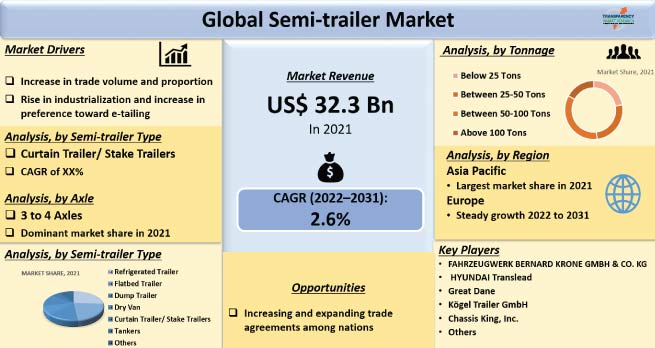
Transparency Market Research has published a new report titled, “Semi-trailer Market (Semi-trailer Type, Tonnage, Axle, End-use Industry, and Region) - Global Industry Analysis, Size, Share, Growth, Trends, and Forecast, 2018 – 2026”. According to the report, the global semi-trailer market is anticipated to surpass US$ 24 Bn by 2026, expanding at a CAGR of more than 3% during the forecast period.
The market for semi-trailers is anticipated to expand during the forecast period due to industrial expansion that leads to higher demand for semi-trailers in order to transport raw material and goods to end-users and suppliers. Amendment in trade policies fueled road transportation, which in turn is estimated to boost the semi-trailer market.
semi trailer market
Request Sample PDF With Strategic Insights @  - https://www.transparencymarketresearch.com/sample/sample.php?flag=B&rep_id=28718
Rising global population has significantly boosted the demand for consumer goods, thus significant expansion of agriculture and manufacturing industries fueled the demand for semi-trailers. Moreover, development of good road connectivity is propelling the market for semi-trailer. Cost-effectiveness of transportation by semi-trailers is a key factor driving the semi-trailer market owing to the high cargo-carrying capacity of the vehicle. Increased spending by governments in order to improve road connectivity is likely to drive the semi-trailer market during the forecast period. Such high investment for road connectivity development after the Second World War resulted in the development of significantly large road transportation and semi-trailer markets. Low speed of the semi-trailer and presence of smaller roads and sharp turns on roads are major factor restraining the semi-trailer market due to its large size and large turning radius. Massive backlog in proper maintenance of roads is also a major factor that is likely to hinder the demand for road freight transportation during the forecast period. Furthermore, toll roads or booths lead to considerable time loss, which results in slow transportation of freight. Poor road infrastructure coupled with a lack of intent to improve transport facilities is expected to restrain the demand for road freight transportation and consequently, hamper the semi-trailer market during the forecast period.
In terms of semi-trailer type, factors driving the expansion of each type of semi-trailer is different. For instance, products that need to be maintained at a specific temperature range are transported through refrigerant or reefer trailers, while different types of semi-trailers are utilized to transport pallets to different regions owing to their regulatory norms and weather dynamics. Moreover, dry vans are highly preferred for transport of cargos. Consequently, the dry van segment held a significant share of the global semi-trailer market owing to the high rate of adoption of dry vans in North America and Mexico.
Across regions, the market for semi-trailer varies largely in terms of semi-trailer type, tonnage, and axles. On a broader scale, in terms of revenue, North America held a prominent share of the global semi-trailer market, while in terms of volume, Asia Pacific dominated the semi-trailer market in 2017. High cost of semi-trailers in North America coupled with their high tonnage capacity led the region to hold a major share of the global market, in terms of revenue, despite holding a lower share of the global semi-trailer market, in terms of volume. In North America, dry vans are highly popular, which are more expensive than stake trailers that hold a notable share of the market in Asia Pacific.
Key manufacturers operating in the global semi-trailer market are China International Marine Containers (Group) Ltd., FAHRZEUGWERK BERNARD KRONE GMBH & CO. KG, Great Dane, HYUNDAI Translead, Kögel Trailer GmbH, Chassis King, Inc., LAMBERET SAS, Schmitz Cargobull, Schwarzmüller Group, Shandong Arima group, Shandong Liang Shan Huayu Group, Wabash National Corporation., Utility Trailer Manufacturing Company, Dorsey Trailer, MANAC INC., Polar Tank, and Fontaine Commercial Trailer, Inc. China International Marine Containers (Group) Ltd and Schmitz Cargobull are major manufacturers of semi-trailers, which contributed to a prominent share in the global semi-trailer market.

First and Last Mile Delivery Market to Reach US$ 1,100 Mn by 2026

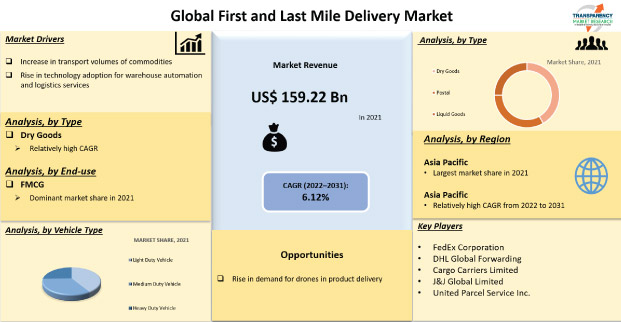
Transparency Market Research has published a new report titled, “First and Last Mile Delivery Market (Vehicle Type: Light Duty Vehicle, Medium Duty Vehicle, and Heavy Duty Vehicle; Cargo Type: Dry Goods, Postal, and Liquid Goods; End-use: Chemical, Pharmaceutical & Healthcare, FMCG, Hi-tech Product Industry, Food and Beverage, and Others) - Global Industry Analysis, Size, Share, Growth, Trends, and Forecast, 2018–2026.” According to the report, the global First and Last Mile Delivery Market is projected to surpass US$ 1,100 Mn by 2026, expanding at a CAGR of 14.77% during the forecast period.
According to the report, the global first and last mile delivery market is likely to be driven by a range of macroeconomic and industry-specific factors. Asia Pacific is expected to be at the forefront of global demand, with the market in the region expanding at a CAGR of 18.23% between 2018 and 2026.
first and last mile delivery market
Request Sample PDF With Strategic Insights @  - https://www.transparencymarketresearch.com/sample/sample.php?flag=S&rep_id=60984
The first and last mile delivery of product distribution is vital to any merchant. The first mile always indicates the movement of goods from retailer to courier service or anyone who supplies the goods to the end-user or final distributer, while last mile denotes the final stage of movement of goods to its final customers.
Supply chain management providers are adopting innovative and latest technologies in order to enhance their availability, elasticity, sustainability, and efficiency. Several customers are willing to pay additional or extra charge for delivery or for immediate delivery, which in turn is projected to fuel the demand for first and last mile delivery in the near future. Adoption of cyber physical system-based service and use of sophisticated and metaheuristic algorithms are boosting the productivity of fist and last mile delivery solutions. Digitization in supply chain, such as integration of major technologies such as smart logistics and warehousing, and critical analysis of information are anticipated to increase the demand for first and last mile delivery in different industries. This, in turn, is likely to propel the first and last mile delivery mile market during the forecast period. Furthermore, increase in urbanization which leads to a more concentrated consumer market, drastic change in consumer behavior, and increase in use of digital platforms for purchase are likely to propel the first and last mile delivery market during the forecast period.
In terms of vehicle type, the global first and last mile delivery market has been bifurcated into light duty vehicle, medium duty vehicle, and heavy duty vehicle. In terms of revenue, the light duty vehicle segment accounted for a major share of the market in 2017. Moreover, retail price, acceleration, fuel economy, interior volume, and ease of operation of light duty vehicles in urban areas prompts most logistic companies to prefer light duty vehicles. Road logistics and transportation activities are increasing across the globe. However, road transport contributes to significant share of carbon emission globally. Stringent emission norms and development of electric vehicles by OEMs are likely to boost the light duty vehicle segment during the forecast period.
In terms of end-use, the first and last mile delivery market has been segregated into chemicals, pharmaceutical & healthcare, FMCG, food and beverage, hi-tech product industry, and others. The FMCG segment is anticipated hold a major share of the market during the forecast period. Shift of preference of urban consumers from essential to premium products, attractive supply chain solutions provided by logistic companies, increase in accessibility of online stores, and expansion of e-commerce industry are projected to fuel the FMCG segment during the forecast period.

On-demand Transportation Market is Exceed US$ 350 Bn by 2026

Transparency Market Research has released a new market report titled “On-demand Transportation Market (Type: Ride Sharing, Vehicle Leasing/Rental, and Ride Sourcing; Business Model: P2P, B2B, and B2C; Vehicle Type: Passenger Cars, LCVs, HCVs, Buses & Coaches, and Micro-mobility; Autonomy Level: Manual, Semi-Autonomous, and Autonomous; Power Source: Fuel Powered, HEV, PHEV, and BEV; Application: Passenger Transportation and Goods Transportation, and Region: North America, Europe, Asia Pacific, Latin America, and Middle East & Africa) – Global Industry Analysis, Size, Share, Growth, Trends, and Forecast, 2018–2026.” According to the report, the global on-demand transportation market is expected to expand at a CAGR of about 14% during the forecast period.
on demand transportation market
Request Sample PDF With Strategic Insights @  - https://www.transparencymarketresearch.com/sample/sample.php?flag=B&rep_id=55536
The transportation industry is undergoing significant transformation and people are adopting online booking applications in order to book a mode or means of transportation. Rising traffic congestion and high fuel cost are key factors driving the adoption of on-demand transportation services. Adoption of smartphone-based internet services is rising among consumers, primarily due to the increased usage of smartphones, ease of operating the app, faster internet connectivity, and presence of globally leading and local service providers coupled with lower charges of services. High cost of vehicle ownership is encouraging people to prefer on-demand transportation services owing to their cost effectiveness and availability as per the requirement. Furthermore, on-demand transportation is an effective solution for the rising traffic congestion, as higher vehicle ownership is likely to boost the number of vehicles on road. Less number of vehicles per 100 people, increase in number of daily commuters heading to workplaces and homes, increased burden on public transportation facilities due to rapid urbanization, and lack of proper connectivity of public transportation systems are fueling the demand for on-demand transportation services. On the other hand, public transportation facilities across the globe are failing to cater to the demand, due to increasing urbanization and rising population. Increase in number of working class people, rise in income opportunities, increase in per capita income coupled with increased tendency to travel for work and holidays are fueling the demand for on-demand transportation services across the globe.
Countries from Europe and North America are well-developed and witness extensive adoption of advanced technologies and smartphones. Availability of faster internet connectivity and presence of globally leading service providers coupled with higher rate of adoption from consumers led the organized sector to hold a major share of the market in North America and Europe. However, in other regions, the unorganized segment accounts for major share of the market, in terms of revenue. Vehicles utilized in the unorganized sector are generally privately owned. These are considered as private services, as unorganized services cannot be availed through internet or smartphone-based apps.
In terms of type, ride sourcing is an emerging trend across the globe, in which consumers can book a ride via a smartphone-based app. Ease of operating the app, increased penetration of smartphone users, and availability of reliable internet services are fueling the demand for ride sourcing services. Ride sourcing services are flexible and hence, a large number of consumers traveling to workplaces, homes, to restaurants, and colleges prefer ride sourcing services. Thus, the demand for ride sourcing services is increasing owing to an increase in the working class population. Low rate of motorization, lack of adequate public transportation facility, crowded public transportation, and increase in fuel prices coupled with elimination of driving are fueling the ride sourcing segment of the global on-demand transportation market. The ride sourcing segment of the market is anticipated to expand at a CAGR of about 20% during the forecast period.

tech