Thursday, January 2, 2020

Elevator Market to be worth US$151.26 Bn by 2026

According to a new market report published by Transparency Market Research (titled “Elevator Market (Deck Type –Single Deck and Double Deck; Destination Control – Smart and Conventional; Building Height – Low Rise, Mid Rise, High Rise; End-use – Residential, Commercial, Mix Block; Speed – Less than 1m/s, Between 1 to 3 m/s, Between 4 to 6 m/s, Between 7 to 10 m/s, Above 10m/s; Application – Passengers, Freight) – Global Industry Analysis, Size, Share, Growth, Trends, and Forecast, 2018 – 2026,” the global elevator market was valued at US$ 59.26 Bn in 2017 and is expected to reach US$ 151.26 Bn in terms of revenue by 2026, expanding at a CAGR of 11.1% from 2018 to 2026. In terms of volume, the market stood at around 773.8 Thousand Units in 2017. Asia Pacific is projected to show the fastest growth rate during the forecast period due to the increase in number of high rise buildings and rapid urbanization.
The increasing demand for skyscrapers in the cities of Asia Pacific is helping to boost the high rise elevator market in the region. Factors such as increasing aging population and demand for accessible housing and infrastructure are contributing to the growth of the elevator market.
global elevator market
Request to Access Market Data @
https://www.transparencymarketresearch.com/sample/sample.php?flag=S&rep_id=14837

By deck type, single deck elevator has the highest growth opportunities as it is cost effective and ideal for moderate traffic. Double deck elevator consists of two cabins attached together. Depending on which floor passengers need to go, they can either take the upper or lower deck if they are intended to go either to even or odd floors.
By destination control, the smart elevator segment is expected to rise with new features, enabling passengers to first select the floor they want and then take them to their destination with the fewest number of stops. These elevators are faster and more energy efficient than conventional elevators.
By building height, mid rise segment constitutes the major share in the global elevator market. However, demand for skyscrapers in Asia Pacific countries is increasing, helping to boost the high rise elevators market in the region
By end-use, mix block segment is expected to expand at the highest CAGR during the forecast period as compared to the residential and commercial segment.
By speed, the segment between 1 to 3 m/s has the major share in the global elevator market. However, due to rapid growth of high rise buildings, between 4 to 6 m/s segment is increasing rapidly.
By application, passenger elevators are the most commonly used. Freight elevators are mostly used in the commercial sector to transport goods from one floor to another.
Geographically, in terms of revenue, Asia Pacific held the largest market share in the elevator market in 2017. After Asia Pacific, Europe has the largest share in the market. The Asia Pacific region is estimated to witness the fastest growth during the forecast period. China, India, and Japan have the highest growth rate as compared to other countries in the Asia Pacific region. South America is expected to show slow growth as compared to the other regions of the world.
The elevator market consists of a large number of dominant players. Industry players focus on advance techniques to increase the speed of the elevators, thereby reducing travel time. Product innovation, especially in case of smart elevators help passenger to manage and monitor physical access to sites. The advancement in technology helps to integrate access control. Otis Elevator Company, KONE Oyj, Schindler, Fujitec Co., Ltd., Hitachi, Ltd., Hyundai Elevator Co., Ltd., Electra Elevators, Mitsubishi Electric Corporation, Thyssenkrupp AG, and Toshiba Corporation are the key companies profiled in the research report. The report also offers competitive landscape of the key players in the elevator market.

Monday, December 30, 2019

In-line Pumps Market Trends, Share, Scope, Research Insights by 2026

In-line pumps are centrifugal pumps which have both vertical and horizontal shaft, with the suction and discharge connections in the casing in line with each other. The in-line design eliminate the need for costly foundations and guarantees low space requirements. The bracket and motor assembly can be separated from the casing without disturbing the piping. The primary difference between both types i.e. vertical and horizontal is the shape and position of the shaft. In a horizontal centrifugal pump, the shaft is normally in a horizontal position. It is sometimes overhung or placed between the bearing design. In case of a vertical pump, the shaft is in vertical position; it is always an overhang position. Convenience and space restriction are the factors to be kept in mind while making a choice between horizontal and vertical inline centrifugal pumps.
In-line Pumps Market - Drivers and Restraints
Rising industrialization and construction activities increases the demand for in-line pumps in urban areas. Rising urbanization is another driver supporting the increasing construction activities in urban areas. In modern farming and agriculture, farmers are using in-line pumps to irrigate the land and enhance the production. Depletion of ground water levels are likely to fuel the demand for in-line pumps due to increasing demand for clean water. Increasing industrialization and manufacturing activity will increase the amount of wastewater. Hence, companies and municipal corporations are likely to focus on wastewater treatment plants and desalination plants to clean the water and reduce water pollution. Rising demand for energy efficient pumps in oil and gas and other energy efficient sectors are driving the market. Implementation of strict rules and regulations by governments especially in the food and beverages sector, and increasing demand for water pumps from the pharmaceutical sector is positively influencing the global in-line pumps market. The high pressure pumps decrease the time and increase the efficiency of manufacturing plants. The major raw material which are used in the production of in-line pumps are iron and bronze. Governments are procuring in-line pumps to extinguish fires without any casualty and damage, thus strengthening the firefighting department. Different pressure rating of pumps are used for different application. Heating and air conditioning, circulating water services, pressure boosting etc. are the applications for which in-line pumps are used.
Access Market Data by Requesting Sample PDF @  https://www.transparencymarketresearch.com/sample/sample.php?flag=S&rep_id=60336
There are some restraints which can affect the demand for in-line pumps. These pumps require large headroom for installation and maintenance especially when it comes to multistage units or turbine pumps. Sometimes it is difficult to balance the hydraulic axial thrust especially when there is high suction pressure due to the overhang design. Another disadvantage which can impact the performance of vertical in-line pumps is that any leakage from the seal of the pump will collect around the top of the casing and it can cause corrosion of the casing, rather than getting drained. Horizontal in-line pumps cannot be used for high temperature applications.
In-line Pumps Market - Segmentation
The global in-line pumps market can be segmented based on product type, applications, and region. On the basis of product type, the in-line pumps market can be classified into vertical and horizontal. In terms of applications, the in-line pumps market can be classified into heating, air conditioning, hot water, snowmelt, and others (pressure boosting, liquid transfer, general industrial service, etc.). Based on region, the in-line pumps market can be divided into North America, Europe, Asia Pacific, Middle East & Africa, and South America.
In-line Pumps Market- Key Players
Key players in the global in-line pumps market are Patterson Pump Company, TUMA Pump Systems GmbH, Grundfos Pumps Corporation, Peerless Pump Company, Crane Pumps & Systems Inc., Dab Pumps Spa, CECO Environmental, Kirloskar Brothers Limited, and DESMI A/S.

Specialty Printing Consumables Market is to be Worth US$ 130.17 Bn by 2026

According to a new market report published by Transparency Market Research titled ‘Specialty Printing Consumable Product Market - Global Industry Analysis, Size, Share, Growth, Trends, and Forecast, 2016–2026,’ the global specialty printing consumables market is expected to reach a value of US$ 130.17 Bn by 2026. In terms of value, the market is estimated to expand at a CAGR of 4.5% during the forecast period from 2018 to 2026. Rise in the use of printing consumables in offices and institutions and a need for large scale printing are projected to drive the market during the forecast period. An expansion in the textile printing industry is projected to lead to an increase in the application of digital printing technology in the market in the near future. The construction, development, and expansion of facilities such as colleges, schools, and hospitals is likely to offer considerable growth potential to the specialty printing consumables market in the coming years.
Toner is expected to be a prominent segment of the specialty printing consumable market. Toners are utilized in fax machines, copiers, and laser printers. They are used in printer cartridges, which require dry toners. Liquid toners are required in bulk quantities for industrial printing. In terms of product, the specialty substrate segment is anticipated to expand at a CAGR of around 5.2% during the forecast period. Based on printing process, the digital printing segment is expected to expand at a robust pace in the coming years. Adoption of less time consuming printing technologies and cost-effective techniques is becoming a major trend in the market.
Request Sample PDF With Strategic Insights @  https://www.transparencymarketresearch.com/sample/sample.php?flag=S&rep_id=52008
specialty printing consumable product market
The flexographic printing process segment of the specialty printing consumables market is expected to expand at a steady pace of around 4.7% over the forecast period. Flexographic printing is widely utilized in the packaging industry due to its flexibility of printing on materials such as brown paper and foil. Furthermore, in terms of application, the office and professional segment is expected to expand at a CAGR of 4.7%. a It is a prominent segment of the specialty printing consumables market in terms of revenue. Increase in the number of printer installations and improvement in digital technology are likely to drive the segment.
The specialty printing consumables market in Asia Pacific and South America is projected to expand at a rapid CAGR during the forecast period. The growth of the market in Asia Pacific is attributed to an expansion in the packaging industry in Japan and China due to a rise in the number of convenience stores and the popularity of ready-made meals in these countries. The market in the region is expected to expand at a CAGR of 4.8% during the forecast period. The market in North America is expected to expand at a CAGR of 4.5% from 2018 to 2026. The advent of 3D printing and its adoption in the construction industry has revolutionized the U.S. construction industry. An increase in demand for specialty printing consumables from the industrial sector is likely to boost the market in the near future.
Some of the major players in the global specialty printing consumables market are DIC Corporation, Canon Inc., Xerox Corporation, HP, Eastman Kodak Co., Flint Ink Inc., Nazdar Ink Technologies, L.P., Lexmark International Inc., and Fuji Photo Film Company Limited.

Mattress and Mattress Component Market Analysis, Trends and Forecast by 2026

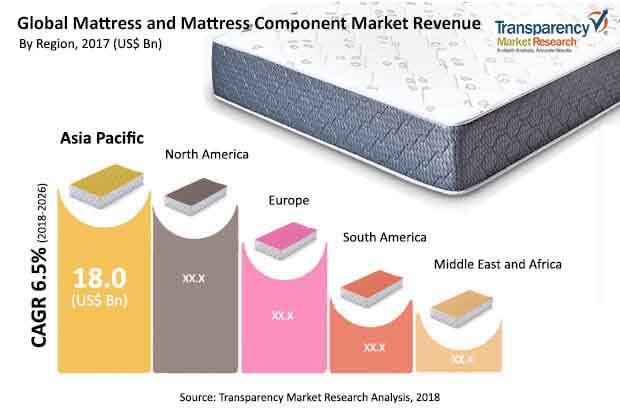
Global Industry Analysis, Size, Share, Growth, Trends, and Forecast, 2018 – 2026,” the global mattress and mattress component market is expected to reach US$ 83.6 Bn and US$ 30.2 Bn by 2026, expanding at a CAGR of 6.5% and 5.2% from 2018 to 2026. Asia Pacific held the dominant share in the mattress and mattress component market in 2017.
With growing consumer preference and huge market potential, the mattress market is expected to witness considerable growth in the coming years. Globally, innerspring mattress type dominates the market in terms of revenue. Innerspring mattress segment held the largest share in the global mattress market. Innerspring mattress constituted majority share in terms of revenue in the Asia Pacific mattress market in 2017 and this trend is expected to continue over the forecast period. Growing health issues due to sleep disorder among consumers are propelling the demand for good quality mattresses. With the increasing disposable income, most customers are ready to pay extra for health benefits as well as luxury bedding products for luxurious, comfortable sleep. Apart from this, the increasingly busy schedules of people are inducing mental tiredness in them, making sound sleep a compulsion. All these factors are anticipated to drive the mattress and mattress component market during the forecast period.
global mattress and mattress component market
In terms of mattress size, queen size mattress occupied the largest market share in the overall mattress market in 2017 and this trend is expected to continue over the forecast period. Queen size mattresses are the most cost effective size. These mattresses are an ideal choice for couples who are looking for floor space-friendly as well as cost-effective mattresses. Hence, demand for this particular mattress size is on the rise and is anticipated to maintain its position during the forecast period from 2018 to 2026. 
Growth in the mattress industry is driven by rise in construction activity influenced by economic development. Both commercial and residential construction is on the rise globally especially in the U.S. Housing and hospitality sectors are primarily supporting this growth. The commercial sector, which includes hotel industries, offices, and institutions, and healthcare industry, has seen robust growth in the past few years and is expected to witness similar growth in the coming years. Growing construction expenditure in emerging markets such as Asia Pacific will further strengthen demand. In addition, considerable growth in the hotel industry was observed in the Asia Pacific region with almost 350 new hotels and around 90000+ rooms opened in 2017. Majority of homeowners are undertaking home improvements to refurbish and to add value to their houses. Remodeling homes is the most popular renovation followed by wallpapering, painting, and carpeting among others. Consumers spend lavishly on home renovation in developed regions such as the U.S. and the U.K due to improved economic conditions. During home renovations, different shapes and sizes of mattresses (square, circular and semi circular, polygon or hexagon, and triangular among others) are purchased. Thus, it is expected to increase the demand for mattresses in these regions over the forecast period.
Asia Pacific held the largest market share in the mattress market and acquired more than 37% share in 2017. It is anticipated to be the most swiftly developing region due to rising adoption of health beneficial mattresses in the developing economies of China and India. China was the major contributor to the growth of the Asia Pacific mattress market. Moreover, China is the largest mattress market globally followed by the U.S. Asia Pacific was followed by the markets in North America and Europe. Asia Pacific is the largest as well as the fastest growing regional market owing to rising number of health conscious people who are ready to pay considerable amounts for products that are beneficial to health. All these factors have propelled the growth of the mattress market in this region. Other developing regions such as the Middle East and Latin America are expected to become new revenue generating areas for large mattress dealers.
Companies are focusing on achieving long-term growth through value added services The mattress market is highly competitive where top five players occupied more than half of the market share in the overall mattress industry in 2017. Major players in the mattress market include Tempur-Pedic International, Inc., Simmons Bedding Company LLC, Serta, Inc., Spring Air Company, Select Comfort, Southerland Bedding Co., Sealy Corporation, Kingsdown, Inc., King Koil, Inc., Zhejiang Huaweimei Group Co. Ltd., Silentnight Group, and Relyon Limited among others.

Automotive Cooling Fan Market is to be Worth US$ 64 Bn by 2026

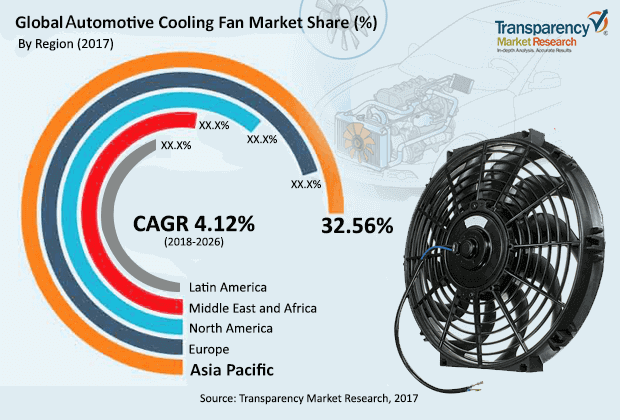
Transparency Market Research has published a new report titled, “Automotive Cooling Fan Market - Global Industry Analysis, Size, Share, Growth, Trends, and Forecast, 2018–2026.” According to the report, the global automotive cooling fan market is projected to exceed US$ 64 Bn by 2026, expanding at a CAGR of more than 4% during the forecast period.
According to the report, the global automotive cooling fan market is likely to be driven by a range of macroeconomic and industry-specific factors. Europe is expected to be at the forefront of global demand, with the OEM market in the region expanding at a CAGR of about 7% between 2018 and 2026.
automotive-cooling-fans-market.png
Request Sample PDF With Strategic Insights @  https://www.transparencymarketresearch.com/sample/sample.php?flag=S&rep_id=38144
Several systems of vehicles such as engine cooling, transmission, and HVAC require a cooling system. The thermal efficiency of these components has a direct impact on the fuel economy, performance, and comfort of a vehicle. The cooling system plays a crucial role in modern vehicles owing to all the parameters mentioned above. The modern trend in the automotive industry toward manufacturing of powerful engines, which generate high heat and require cooling fans, has been rising consistently in recent years. Increase in passenger vehicle sales across the globe is a major factor driving the global automotive cooling fan market. Most OEMs are integrating the latest technologies along with advance electrical systems that require cooling for better performance. Increasing demand for latest technology and the rise in demand for enhanced fuel-efficiency in vehicles are key factors that are likely to boost the automotive cooling fan market during the forecast period.
The global automotive cooling fan market has been segmented based on type, vehicle type, and region. In an internal combustion engine, the radiator plays an important role in cooling the engine. For better comfort, the air conditioning system is provided by auto manufacturers. The air condenser fan converts the refrigerant into a liquid form. The condenser fan absorbs all the heat from the air conditioning system by providing air to the condenser. Demand for air conditioning system is increasing owing to the increase in vehicle production. Consequently, the adoption of condenser fans is expected to rise during the forecast period.
Based on vehicle type, the global automotive cooling fan market has been bifurcated into passenger vehicle, commercial vehicle, and electric vehicle. In terms of revenue, the passenger vehicle segment accounted for a major share of the market in 2017. Rising production of passenger vehicles across the globe is propelling the global automotive cooling fan market. Internal combustion engine-powered passenger vehicles contain radiator fans, ventilation fans, and condenser fans in order to maintain the appropriate temperature of vehicle parts. Adoption of advanced electronics components along with latest technologies in passenger vehicles is likely to boost the automotive cooling fan market during the forecast period. Increase in production and sales of electric vehicles across the globe is a major factor that is likely to boost the global automotive cooling fan market during the forecast period. Battery electric vehicles contain electronic systems, infotainment systems and batteries, which require fans for cooling purposes. Government initiatives toward green transportation and stringent emission norms are anticipated to boost the battery electric vehicle segment, which in turn is projected to drive the automotive cooling fan market, during the forecast period. Electric vehicles require more fans than normal vehicles owing to the incorporation of batteries and more number of electrical systems in electric vehicles.

Automotive AC Compressor Market is to be Worth US$ 32.39 Bn by 2026

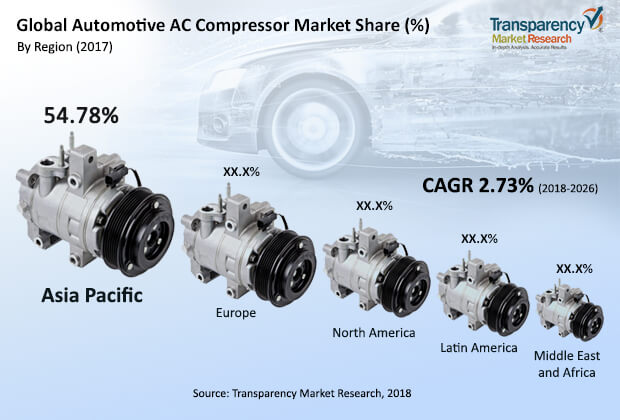
According to a new market report published by Transparency Market Research, “Automotive AC Compressor Market  - Global Industry Analysis, Size, Share, Growth, Trends, and Forecast, 2018–2026” is expected to reach US$ 32.39 Bn by 2026, expanding at a CAGR of more than 2% during the forecast period.
The global automotive AC compressor market is projected to expand at a CAGR of more than 2% between 2018 and 2026, according to a new research report by Transparency Market Research (TMR). According to the report, the global market is likely to be influenced by a range of political, economic, social, technical, and industry-specific factors. Latin America is expected to witness rapid rise in demand for AC compressors, and the market in the region is anticipated to expand at a CAGR of nearly 3% during the forecast period.
Request Sample PDF With Strategic Insights @  https://www.transparencymarketresearch.com/sample/sample.php?flag=S&rep_id=38399
automotive ac compressor market
Request a Sample of Automotive AC Compressor Market - https://www.transparencymarketresearch.com/sample/sample.php?flag=S&rep_id=38399
Currently, global warming is a major issue that is affecting the lives of people. Temperature of the environment is increasing by one to two degrees every year. Transportation in such weather conditions is not easy. Vehicles are equipped with AC units in order to curtail these problems, which regulates the temperature of the vehicle interior. There are two broad segments of AC compressors: electrical and conventional. Convectional compressors directly run through the engine, via a belt, which exerts pressure on the engine, leading to increase in vehicle emission. Increase in vehicle emission leads to a rise in global warming, as vehicular emission has greenhouse gases such as CO2 and methane. Electric vehicles have been introduced in the market in order to deal with the issue of vehicle emission. For electric vehicles, an electrical AC compressor is used. An electrical AC compressor is also utilized in premium vehicles. Demand for premium vehicles has increased due to the increase in standard of living and purchasing power capacity. Furthermore, demand for zero emission vehicles is increasing in order to overcome the problem of deteriorating environmental conditions.
The automotive AC compressor market can be segmented based on design type, drive type, sales channel, vehicle type, and region. In terms of design type, the automotive AC compressor market can be divided into reciprocating and rotary. The reciprocating segment can be further sub-divided into swash type and wobble type. Reciprocating type was a leading segment of the AC compressor market in 2017 due to the higher usage and easily availability of wobble type of AC compressors in all types of vehicles including hatchbacks and heavy commercial vehicles. Their effectiveness to work in normal conditions and low prices of its components make wobble type compressors highly preferable in countries of Asia Pacific, such as India and Indonesia, where vehicle production is significantly high. The scroll sub-segment of the rotary segment witnessed expansion at a higher growth rate, as compared to the other segments of the market, in terms of design type. Increase in usage of premium vehicles with better performance is driving the scroll sub-segment of the market. However, it is employed in several vehicles, in spite of being expensive, owing to its compact in size and low noise generation. In terms of revenue, the scroll-rotary sub-segment is expected to reach US$ 8 Bn by the end of 2026, expanding at a CAGR of more than 3% during the forecast period.
In terms of drive type, the global AC compressor market can be bifurcated into electrical AC compressor and conventional AC compressor. The conventional AC compressor is directly driven by the vehicle engine through a pulley connected via the V-belt. These type of compressors exert considerable pressure on the engine, leading to higher fuel consumption. The conventional AC compressor segment held a prominent share of the market, and its share is likely to reach about 89% of the market by the end of 2026. The conventional segment dominated the market and is likely to hold a prominent share of the market by end of forecast period. Economy of sub-regions such as the Middle East and some parts of Asia Pacific strongly depend on fuels. Hence, in such sub-regions, the conventional IC engine is likely to be utilized in the near future. Therefore, the conventional segment of the market in Middle East & Africa is likely expand during the forecast period. Rising trend of electrification of vehicles is anticipated to drive the electric segment of the AC compressor market. Rising penetration of electric vehicles, due to offering of incentives, subsidies from governments in order to protect the environment, and developing infrastructure are anticipated to boost the electric AC compressor segment.

Fiber Optic Testing Equipment (FOTE) Market Size, Share, Trends, Forecast 2025

The global fiber optic testing equipment (FOTE) market is fragmented due to the presence of large number of players, observes Transparency Market Research.  Leading players in the market are developing products with advanced technology. They are also engaged in expansion procedures to get larger geography under their purview. As customers are demanding for after sales services, advanced features, and continuous product support and customer services while purchasing has pushed players to continuously use new technologies for product development.
Players are also investing in merger and acquisition, partnership, and collaboration. For example, recently Fluke Corporation acquired small players including eMaint Enterprises and Hawk IR International. Few players analyzed in the report are EXFO Inc, Keysight Technologies, Tektronix Inc, JDS Uniphase Corporation, Yokogawa Electric Corporation, and Fluke Networks.
The global fiber optic testing equipment market is expected to progress at a CAGR of 5.7%
over the projected period between 2017 and 2025. Over this period, the market is expected to earn US$0.93 bn, progressing from US$0.57 bn earned in 2016. All these figures are stated in terms os revenue. Based on product type, the demand in the optical time domain reflectometer (OTDR) segment is more as compared to other products. This segment is likely to hold dominant share in the market and is likely to maintain its position over the forecast tenure.
Developing defense sector in emerging economics where there is a substantial need for fiber optic testing equipment has brought Asia Pacific as a leading region in this market. Moreover, increasing use of fiber optic devices in telecommunication is also expected to spur growth the global fiber optic testing equipment market in Asia Pacific. The Middle East and Africa is also expected to contribute in growth of this market. Increasing use of smartphones and other electronic devices has fueled demand for fiber optic instruments in this region.
Request Sample PDF With Strategic Insights @ https://www.transparencymarketresearch.com/sample/sample.php?flag=S&rep_id=23891
fiber optic testing equipment market
Increasing Demand for High Performance Data Transfers Techniques to Boost Market Growth
One of the biggest benefit of fiber optic communication systems is that it has revolutionized the telecommunication industry at a large. Developments taking place in broadband infrastructure in various regions is expected to fuel growth in the global fiber optic testing equipment market. Moreover, increasing demand for high performance and faster data transfers is boosting growth in the global fiber optic testing equipment market.
Furthermore, fiber optic testing equipment helps in meeting the higher bandwidth needs required by high-definition electronic products, and in increasing use of digital technologies. Rapid deployment of FTTX is also estimated to expand the global fiber optic testing equipment market. Adding further, growing business services and multimedia houses are contributing in the growth of the global fiber optic testing equipment market.

tech