Sunday, March 1, 2020

Cryptocurrency Market to reach US$ 6,702.1 mn by 2025 | TMR

The growing popularity of digital currency has played an integral role in driving sales across the global cryptocurrency market. The use of digital ledgers and blockchain technology across the financial space has emerged as an important dynamic of market growth. Moreover, investments in various forms of cryptocurrency have led to market growth and maturity. Several industry analysts consider cryptocurrency as a lucrative digital currency that could revolutionize the area of transactions. The availability of digital ledgers floating across the cryptocurrency ecosystem has helped in reconciling the use of this currency. Considering the factors stated above, it is legit to believe that the global cryptocurrency market would gain momentum in the times of follow.
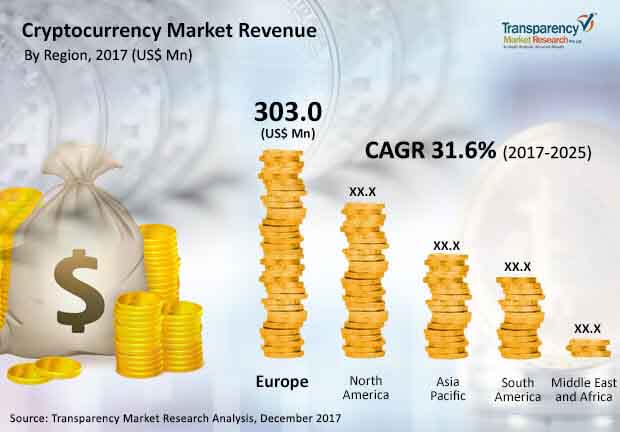
Transparency Market Research (TMR), in it report, predicts that the global cryptocurrency market would grow at a boisterous CAGR of 31.30% over the period between 2017 and 2025. The total value of the global cryptocurrency market is set to touch a soaring mark of US$6.7 bn by the end of 2025. The stellar growth of this market can be attributed to the fading popularity other currencies. Moreover, the quest to embrace digital currencies is impelled by the availability of blockchain technology and digital ledgers. Analysts in the cryptocurrency industry are making tall claims about the potential and feasibility of this technology.
Request Sample PDF With Strategic Insights @  https://www.transparencymarketresearch.com/sample/sample.php?flag=S&rep_id=38240
cryptocurrency market
China Emerges as an Innovator in the Domain of Digital Currency
China has been at the forefront of growth within the global cryptocurrency market. China and South Korea have made voluminous investments in cryptocurrency mining sites, and this is an important trend within the global market. Furthermore, ‘Ethereum’ is a known cryptocurrency giant that had once established its foothold in these countries. The impact of this past trend manifest in the stellar pace of growth within the regional cryptocurrency market. Several other countries are also expected to join the league of nations that mine cryptocurrency. This trend shall help in generating fresh revenues across the global cryptocurrency market. 
Worldwide Popularity of Bitcoin
Bitcoin has been the most popular cryptocurrency across global markets. The relevance of bitcoin transactions in terms of security, utility, and asset creation has played to the advantage of the market. However, bitcoin miners still face the wrath of inspection authorities in regions where the currency has been banned. Furthermore, bitcoin has also been under flak for its humongous usage of electricity. The energy sector has advocated for bans and restrictions on mining of cryptocurrency in several regions. Despite these unfavourable factors, the global cryptocurrency market is growing at a stellar pace in recent times.

Some of the leading vendors operating in the global cryptocurrency market are Microsoft Corporation, NVIDIA Corporation, and Intel Corporation. Emergence of new cryptocurrencies other than bitcoin has played to the advantage of the leading market vendors.

Mobile Satellite Services (MSS) Market to reach US$6955.3 Mn by 2025 | TMR

As per recent studies, mobile satellite services require high initial investment, which has rendered the market moderately competitive. The prominent companies in the market primarily compete on the basis of performance, product quality and features, technology, and innovation. Besides this, several vendors around the world are deploying solutions either independently or alongside channel partners intending to consolidate larger share in the global mobile satellite services market. To sustain growth amidst intensifying competition, the market players are keen on pacing up with emerging technologies to keep their product lines up-to-date. According to a new study by Transparency Market Research (TMR), Echostar Corporation, Ericsson AB, GlobalStar Corporation, Inmarsat Inc, Intelsat, S.A., Iridium Communications, Inc., ORBCOMM, Inc., Singtel Satellite, Telstra Corporation Ltd., Tesacom, Thuraya Telecommunications Company, and ViaSat Inc. are among the key players operating in the global mobile satellite services market.
In 2017, the global mobile satellite services market was valued at US$3942.3 mn. Rising at a healthy 7.4% CAGR between 2017 and 2025, the global market is likely to reach US$6955.3 mn by the end of 2025. Holding nearly 66.2% of the market based on service type, the data segment emerged dominant in 2016. Its dominance is expected to remain sealed through the aforementioned forecast period. In terms of end-use industry, the market will witnessed the military and defense segment emerge at the fore in 2016. Regionally, North America accounted for the dominant share of 34.7% in the global mobile satellite services market in 2016. However, during the course of the forecast period South America is likely to show the fastest CAGR. Besides this, promising growth is expected in Asia Pacific, as countries such as Australia, Japan, and China exhibit high demand for mobile satellite services.
Request Sample PDF With Strategic Insights @\ https://www.transparencymarketresearch.com/sample/sample.php?flag=S&rep_id=11570
mobile satellite services (mss) market
Demand for Strong Communication Channels to Support Technological Advancements Boosts Growth
These days it is just a matter of time before a newly evolved technology translates into an ongoing trend. For instance, bring your own device practices are adopted globally. However, for its successful implementation, it requires support from a strong communication channel, which is fulfilled by mobile satellite services. Similar technological advancements have chalked the convergence of terrestrial mobile phones and satellites, which experts have identified one of the primary factors enabling growth in the global mobile satellite services market. Given the scenario, starting from the Internet of Things, autonomous driving, and public safety to augmented reality in video games, TMR sees enormous potential on cards for convergence of wireless and satellite industries. Spurred by these factors, the global mobile satellite services market will report a positive growth trajectory in the coming years.
Stringent Regulations Imposed on Satcom Industry to Hinder Growth

With companies increasingly spending in R&D operations the market will witness a spurt of fresh opportunities in the coming years. Furthermore, companies are investing in setting up facilities to analyse and develop novel technologies. Such efforts are likely to give impetus to the global mobile satellite services market in the coming years. In addition, the allocation of additional bandwidth for MS and, integration of MSS into IoT applications are likely to bolster the market’s prospects for growth. On the downside, stringent regulations implemented by government on satcom industry, especially in emerging nations will create challenges for the mobile satellite services market. Also, competition from VSAT mobile technologies and congestion of frequency bands will pose threat to the market players.

Social Media Analytics Market is poised to value US$7,862.1 mn by 2025 | TMR

According to a newly published study, Transparency Market Research expects the worldwide social media analytics industry to demonstrate a high level of competence in a particularly fragmented competitive landscape. As an essential approach to expand their regional horizons, most players participate in mergers and acqisitions. The majority of businesses use a strong capacity in their analytical programs to produce effective statistical data in each social media platform to maximize their geographical reach.
The presence of various players with only surveillance tools, specialized in specific in the vertical sector and others, is also active on the market. The majority of key players give complete suites with a wide range of functions. Niche players, for example, are developing fresh capacities and Dataroma has been developing an analysis platform in real time that shows optimization possibilities. As a result, consolidation through merger & acquisitions in the industry exists with enormous scope. The businesses also leverage their market share and profitability by strategic cooperative projects. These are some of the key growth strategies leveraged by vendors in the global social media analytics market.
Request Sample PDF With Strategic Insights @  https://www.transparencymarketresearch.com/sample/sample.php?flag=S&rep_id=34709
Organizations attempt to analyze revenues and to identify the gaps in different markets. These days, customers have become aware of the brand. It requires better quality, reduced prices and quicker product and service delivery. Advanced analytics are used to assist attain the business objectives. The analytics of social media enables to evaluate unstructured social information in order to react to vibrant markets and to attain high sales and operational return. Organizations can collect enormous quantities of data and automate marketing and operational duties on their markets and clients.
According to TMR analysts, the global social media analytics market was worth US$2.1 bn in 2016. Rising at a 15.47% CAGR over the forecast period 2017 to 2025, the market is poised to reach US$7.8 bn by the year 2025.
Among the different segments, BFSI sector is expected to demonstrate maximum gains in the social media analytics market. North America is expected to rake in significant revenues in the global social media analytics market in coming years.
global social media analytics market
Novel Product Launches to be Key Market Trend
As formal solution supplier to the WhatsApp Business in 2018, Clarabridge Inc. has announced its new position. Selected CX Social brands can now expand their customer service through interacting with their customers via WhatsApp message via the Clarabridge social media management dedicated product. Cision Ltd. announced in 2019 the purchase of the TrendKite analytical company for 225 million USD and a follow-up to its latest software automation approach to enhance social media campaigns. Cision Ltd. TrendKite Inc. makes use for the evaluation of the effect of its job of artificial intelligence.
The launch of such novel products is likely to bolster the social media analytics market to a large extent.
Growing Connectivity to Bolster Social Media Analytics Market
Social Media Analytics ' market adoption is driven by an increased use among individuals of social media. As technology grew, individuals began to use social media for communications, online shopping, and other activities of social connectivity. These encouraged companies to embrace alternatives for social media analytics in order to comprehend users ' requirements and demands and their product salaries. Additional drivers include elevated social media development and analytical instruments as well as rising small and medium-sized business demand. These are some of the leading factors favoring the growth of the social media analytics market in the forthcoming years.

The study presented here is based on a report by Transparency Market Research (TMR) titled, “Social Media Analytics Market (Component - Software (On-premise-based and Cloud-based) and Services (Professional Services and Support and Maintenance); End-use Industry - BFSI, Retail, Telecommunication and IT, Transportation and Logistics, and Media and Entertainment) - Global Industry Analysis, Size, Share, Growth, Trends and Forecast 2017 - 2025”

Underwater Camera Market to be worth US$8946.1 mn by the end of 2025 | TMR

Transparency Market Research observes that the competitive landscape in the global underwater camera market is significant fragmented. Analysts state that increasing number of players are expected make new product launch in order to acquire a share in the overall market. Furthermore, companies are also trying to incorporate features such as GPS, Bluetooth, and Wi-Fi to appeal to the various demands of the end users. Companies are also trying to manufacture versatile cameras at competitive prices to lure in a younger population that has limited disposable income. Some of the key players operating in the global underwater camera market are Panasonic Corporation
Nikon Corporation, GoPro Inc., Canon Inc., Brinno Inc., Sony Corporation, and Garmin Ltd.
According to Transparency Market Research, the global underwater camera market was valued at US$2109.9 mn in 2015 and is expected to reach up to US$8946.1 mn by the end of 2025. During the forecast period of 2017 and 2025, the global market is expected to exhibit a significant CAGR of 15.63%. In terms of sales channel, the online segment is projected to lead the global market as it surges at a CAGR of 16.84%. Geographically, Asia Pacific is poised to do exceptionally well as it is expected to register a CAGR of 16.89% during the forecast period.
Request Sample PDF With Strategic Insights @  https://www.transparencymarketresearch.com/sample/sample.php?flag=S&rep_id=38435
global underwater camera market
New-age Travelers Spike Demand for Underwater Cameras
An increasing number of individuals especially the young population is taking adventure trips in order to experience nature closely. They are keen to observe as well as capture the underwater elements such as ship wrecks, sponges and fishes, among others while experiencing the underwater life. Also, the growing popularity of the social media platforms is impacting the underwater camera market positively. This is owing to the fact that people are eager to share their experiences with their friends and family through the social media platforms. Furthermore, the growing internet penetration is another factor that is driving the growth of the market upwards.
According to Trip Advisor, an online travel review website, the internet is the second most popular source of inspiration for leisure travel among the masses. The commercial segment includes the camera being used by professionals to capture and study underwater life. Additionally, underwater cameras are also used by the professionals of travel channel brands which broadcast travel shows to inspire and provide information to the masses regarding the various travel destinations across the globe.
Development of Robust Underwater Cameras Proves Integral in Research and Surveillance
Availability of sturdy underwater cameras is expected to drive sales in the near future as they serve an important purpose of surveillance of the underwater life. Over the years scientists have studied underwater life that includes ship wrecks, corals, and sponges among others through diving. However, advent of cameras has allowed them explore the uncharted parts of the aquatic world. Underwater cameras have played an integral role in research and study of the water world. Today, robust designs of these underwater cameras has enabled several end users to capture high quality images despite poor natural light. Features such as shockproof and freeze
proof are an added advantage while using these gadgets. Analysts expect that addition of features such as Wi-Fi, built-in GPS, compass, 4-K video recording, and Bluetooth are likely to augment the demand of underwater camera market in the forthcoming years.

This review is based on Transparency Market Research’s report, titled “Underwater Camera Market (End-User – Personal and Commercial; Sales Channel – Online and Offline) – Global Industry Analysis, Size, Share, Growth, Trends and Forecast, 2017 – 2025”.

Warehouse Management Systems Market to touch US$ 6,184.3 Mn by 2027

According to a new market report published by Transparency Market Research entitled “Warehouse Management Systems Market (Component – Software and Services; Software – On-premise and Cloud; On-premise – Labor Management Systems, Analytics and Optimization, and Others; Cloud – Labor Management Systems, Analytics and Optimization, and Others; Services – Consulting, System Integration, and Operations and Maintenance; Application – Retail, Electronics, Food and Beverage, Pharmaceutical, 3PL, and Others) – Global Industry Analysis, Size, Share, Growth, Trends and Forecast, 2017 - 2027,” the global warehouse management systems market was worth US$ 2,114.0 Mn in 2019 and is expected to reach US$ 6,184.3 Mn by 2027, expanding at a CAGR of 14.4% from 2019 to 2027.
The global market for warehouse management systems is driven by technological developments, rising adoption of cloud based warehouse management systems, increased demand from the health care and retail sectors, and strong demand from the Asia Pacific region. The expanding application areas of warehouse management systems along with improved functionality is also generating high demand for warehouse management systems specifically in Europe and the North America region. On the other hand, the warehouse management systems market is hampered by requirement of high initial investment cost for the deployment of on-premise WMS system and lack of ICT infrastructure and system scalability. However, the growing demand for cloud based WMS to reduce operational cost and growing e-commerce market is anticipated to present several growth opportunities over the forecast period.
On the basis of component, the market is segmented into software and service. The software segment further based on the deployment type covers, on-premise and cloud based software. Further, on-premise and cloud based software segments are each categorized into labor management systems, analytics and optimization, and others which includes 3PL billing and yard management. In 2018, on-premise warehouse management software was dominating cloud warehouse management software, however, the industry is observing a phase of change where most of the users are moving from on-premise to cloud solutions.
Request Sample PDF With Strategic Insights @  https://www.transparencymarketresearch.com/sample/sample.php?flag=S&rep_id=3004
On the basis of services, the market for warehouse management systems is segmented into consulting, system integration, and operations and maintenance. In 2018, the operations and maintenance segment held the largest revenue share of around half of the overall warehouse management services market and is expected to maintain its dominant position during the forecast period. Moreover, this segment is also expected to expand at the highest CAGR in terms of revenue during the forecast period from 2019 to 2027.
Based on applications, the global warehouse management system market is segmented into retail, electronics, food and beverage, pharmaceutical, 3PL, and others which includes books and publishing, and home improvement. Third party logistics (3PL) segment is expected to be primary adopter of warehouse management systems in near future. This is owing to third party logistics looking forward to changing their customer experience with the adoption of cloud based warehouse management system.
Geographically, in 2018, Europe is the largest market for warehouse management systems among other regions. Moreover, Asia Pacific is expected to witness the fastest growth during the forecast period. Countries such as India, China, Korea, and Japan are expected to be at the forefront of warehouse management system adoption due to increased technological investment in the region.

Some of the major players in the global warehouse management systems market with the most significant developments are HighJump Software, Tecsys, Inc., Infor Inc., JDA Software Group, Inc., LogFire Inc., Made4net LLC, Manhattan Associates Inc., Oracle Corporation, Reply, SAP SE, Softeon, Inc. and Synergy Logistics Ltd.

Data Broker Market Scope, Size, Share, Trends, Forecast by 2026

Transparency Market Research (TMR) in one of its latest market study reveals the global data broker market to be intensely competitive. Savvy players are actively focusing on to offer customized solutions in order to best serve the requirements of their clients.
Key names in the global data broker market include Experian plc., Oracle Corporation, TowerData Inc., Fair Isaac Corporation, Thomson Reuters Corporation, IBM Corporation, Acxiom Corporation, TransUnion LLC, PeekYou LLC, Datasift Inc., Nielson Holdings Plc, HG Data Company, CoreLogic Inc., H.I.G Capital LLC, Bloomberg L.P., Moody’s Corporation, Ignite Technologies Inc., Qlik Technologies Inc., Equifax Inc., Lifelock Inc., Alibaba Group Holdings Limited, RELX Group plc, Wolters Kluver N.V., and HIS Markit Morningstar Inc.
According to estimates presented by the TMR report, the global data brokers market will clock an impressive 11.5% CAGR for the forecast period between 2017 and 2026. In terms of data category, the demand for consumer data is estimated to contribute more than one-third revenue share of the overall market by the end of 2026. In terms of end-use sector, the BFSI segment holds the leading revenue share and is anticipated to register an above-average growth in the upcoming years. Geography-wise, North America is anticipated to dominate the data broker market over the 2017-2026 forecast period.
Request Sample PDF With Strategic Insights @  https://www.transparencymarketresearch.com/sample/sample.php?flag=S&rep_id=13037
data broker market
Advantages of Insights into Customer Purchasing Behavior a Boon for Market
Today, the incessant use of mobile devices have led to generation of vast amount of consumer data that can be used for business advantage. Enterprises are striving to scrutinize the bulk data that is generated from digital and non-digital peripherals for devising new marketing strategies. In particular, customer-facing businesses are leveraging data analytics to understand trends, consumer behavior, growth opportunities, and purchasing patterns. The task, however, is quite complicated and requires external assistance to be carried out. Data broker products are increasingly being adopted to carry out complex analysis of massive volume of data.
Moreover, moderate regulations that oversee data protection stipulations allow a freehand collection, thus, enable easy buying, selling, and exchange of vital customer data. The scrutiny of this data enables organizations to better formulate marketing strategies and identify potential customers. This is leading to a strong demand for data broker product and services. Data brokers perform the arduous task of data collection from an array of sources, which is later scrutinized to deduce useful analytics. Businesses are purchasing consumer data to obtain information pertaining to customers’ interest areas that reveals his/her purchasing behavior. The data collected by data brokers is not only used to obtain vital customer data but also for tracking potential customers and operation management. This, in turn, will positively influence the global data broker market.
Risk of Compromising Vital Consumer Data Restrains Growth
Although the information fetched by data brokers are typically used for business innovation and for improved customer experience, it draws criticism for intruding into customer privacy. Consumer data may include customer’s email id, contact details and monitoring customer’s online and offline Internet activity. Policy makers and consumer groups remain highly critical of data collection using data brokers and services. Data broker practices have been under the radar lately as they are associated with surging spamming activities and spread of unsolicited promotional messages.

The review presented is based on the findings of a TMR report, titled “Data Broker Market (Data Category-Consumer, Credit, Government, Technical, Real Estate, Education & Training, Product & Services, Risk Management, Other; Data Types-Unstructured Data, Structured, Custom Structure Data; Pricing Model-Subscription Paid, Pay per Use Paid, Hybrid Paid Models; End Use Sector-BFSI, Retail and FMCG, Manufacturing, Media, Government Sector, Other Sectors) Global Industry Analysis, Size, Share, Growth, Trends and Forecast 2017 – 2026.”

Stadium Security Market - Comprehensive Industry Report Offers Forecast and Analysis on 2017-25

The global stadium security market has been prophesied in a report by Transparency Market Research (TMR) to find leading players taking to the adoption of partnerships, collaborations, product development, and mergers and acquisitions to secure stronger shares in the coming years. For instance, a leader in seating system solutions, VDL has recently shaken hands with GP Smart Stadium in a business partnership. The partners would be working toward achieving the goal of successfully deploying modern systems in Iraq’s Basrah International Stadium. The market also includes other prominent names of the industry, viz. Avigilon, AxxonSoft, and Genetec.
By the completion of 2025, the global stadium security market has been projected by TMR to reach a valuation of US$20.20 bn while posting a 12.74% CAGR for the forecast tenure 2017-2025. In 2016, the market had been valued at a US$6.94 bn. By sales channel, it could witness the rise of channel partner collecting higher revenue of US$10.95 bn. On the basis of region, North America has been prognosticated to expand at a whopping CAGR of 13.65%
Request Sample PDF With Strategic Insights @ https://www.transparencymarketresearch.com/sample/sample.php?flag=S&rep_id=13745
Fears of Terrorism Looming Over Public Events Necessitate Stadium Security
Worries about the possibility of reoccurrence of terrorist attacks on large gatherings, especially during sports events, have been anticipated to increase the demand for stadium security. In 2017, the Manchester Arena bombing injured over 500 people and killed 23, including the attacker. Currently, almost every large stadium around the globe has been well-equipped with advanced systems such as intrusion alarms, metal detectors, fire alarms, access control systems, and CCTV cameras.
Stadium owners have been observed to shell out colossal amounts of funds on security systems. Managing misbehaviors of attendees or their sudden outburst due to certain reasons could be a gigantic task to see through. However, with proper stadium security solutions in place, authorities could maintain a positive environment within the arena.
Poor Investment Owing to Dearth of Funds Stunts Development of Some Stadiums
There are still a few stadium owners who lack sufficient funds to maintain security inside and outside the arena. This could also percolate to investments made by owners, causing them to run low as a result of it. Furthermore, indigenous infrastructure of stadiums has been foretold to cause problems to complement smart technologies.
However, increasing frequency of sports events organized in different parts of the world and crowds of enthusiasts attending them could continue to raise the demand for stadium security at a sharp rate. Prompt response promised by security agencies during emergencies or untoward events has been expected to further surge the demand in the near future. After all, providing one-of-a-kind experience and ascertaining the security of visitors are of prime importance in the eyes of stadium authorities.

The information presented in this review is based on a TMR report, titled “Stadium Security Market (Component - Hardware (Access Control System and Video Surveillance System), Software (On-premise-based and Cloud-based), and Services (Installation and Maintenance); Sales Channel - Channel Partners and Direct Sales) - Global Industry Analysis, Size, Share, Growth, Trends and Forecast 2017 - 2025.”

tech