Monday, April 13, 2020

Medium-Voltage Switchgear Market Expected To Reach US$ 8,395.0 Mn By 2026: Transparency Market Research

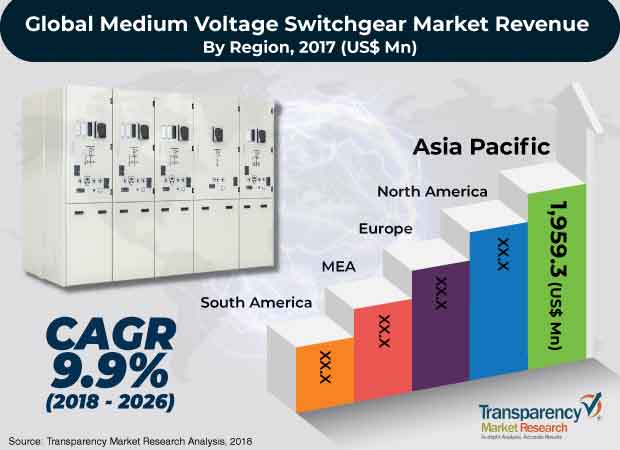
According to a new market research report on the medium-voltage switchgear market, published by Transparency Market Research, the global medium-voltage switchgear market is expected to reach value of US$ 8,395.0 Mn by 2026, expanding at a CAGR of 6.2% from 2018 to 2026. Asia Pacific is likely to continue to lead the global market, with the market in the region expanding at a CAGR of 6.8% between 2018 and 2026.
medium-voltage-switchgear-market-2018-2026.jpg

Request a Sample -  https://www.transparencymarketresearch.com/sample/sample.php?flag=S&rep_id=56043

Grid modernization to reform electricity transmission and distribution networks is driving the global medium-voltage switchgear market

From traditional electricity grids to smart grids, from power grids based on fossil fuels (such as coal and petroleum) to grids integrating renewable energy sources (such as solar and wind power), grid systems play a key role in the electricity sector. Resources such as coal and petroleum are not unlimited or renewable. The faster they are used, the quicker they would be depleted. Energy-saving methods can be attained through advancements in technology and development of new forms of power grids, while improving the production of renewable energy and reducing the emissions of greenhouse gases. Thus, increasing government initiatives for renewal of existing transmission and distribution networks along with grid modernization are expected to propel the demand for medium-voltage switchgear during the forecast period.

Request Brochure Of Report -  https://www.transparencymarketresearch.com/sample/sample.php?flag=B&rep_id=56043

Medium-voltage Switchgear Market: Scope of Report

The global medium-voltage switchgear market has been broadly segmented in terms of voltage, insulation, end-use industry, and geography. In terms of voltage, the market has been classified into 3kV – 5kV, 6kV – 15kV, 17kV – 27kV, and 28kV – 40kV. Among these, the 6kV – 15kV segment accounted for a major market share around 30% in 2017. The segment is expected to expand at a significant CAGR of 6.4% during the forecast period. Based on insulation, the medium-voltage switchgear market has been divided into air-insulated switchgears, gas-insulated switchgears, and others. The air-insulated switchgears segment held the leading share of the market in 2017. Air-insulated switchgears are extensively used in rural areas and favorable offsite terrains, where space, climatic conditions, seismic occurrences, and environment-related concerns is not an issue. In terms of end-use industry, the market has been classified into power plants, commercial sector, oil, gas and petrochemical, utility sector, paper & pulp industry, and others. In 2017, the utility sector segment accounted for a prominent market share. The segment is estimated to expand at a significant CAGR of 5.7% during the forecast period.


Based on region, the global medium-voltage switchgear market can be segregated into North America, Europe, Asia Pacific, Middle East & Africa, and South America. Asia Pacific dominated the global medium-voltage switchgear market in 2017, with China holding a major share of the market in the region. Demand for switchgears in China is primarily driven by increasing investments in electricity transmission and distribution networks across the country, renewal of faulty and aging electricity transmission and distribution networks, and rapid electrification in rural areas of the country. The U.S. dominates the market in North America, owing to increasing usage of medium-voltage switchgears in various electrification projects in commercial and residential sectors across the country. Europe is also expected to contribute significantly to the global medium-voltage switchgear market in the next few years.

Global Nano GPS Chipset Market To Reach US$ 1,221.3 Mn By 2026

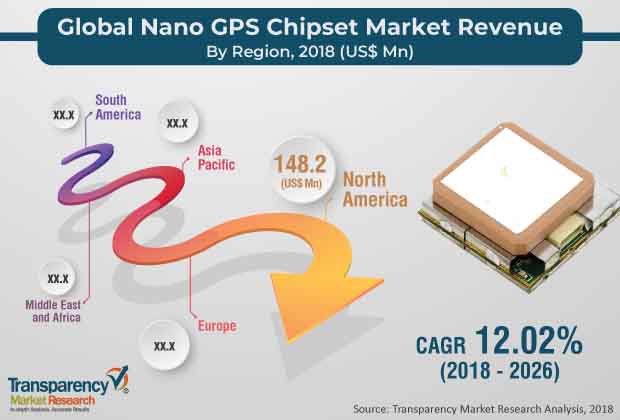
According to a new market research report published by Transparency Market Research titled ‘Nano GPS Chipset Market - Global Industry Analysis, Size, Share, Growth, Trends, and Forecast, 2018 - 2026,’ the global Nano GPS chipset market was valued at US$ 452.7 Mn in 2017 and is expected to expand at a CAGR of 12.02% from 2018 to 2026, to reach value of US 1,221.3 Mn by the end of the forecast period. 
nano gps chipset market
Request a Sample -  https://www.transparencymarketresearch.com/sample/sample.php?flag=S&rep_id=60627
Rising popularity of GPS tracking devices across the globe to fuel the Nano GPS chipset market
Recently, GPS tracking devices are increasingly becoming popular, as they are being used for asset tracking. GPS trackers are being used to track assets by their owners; to track vehicles by fleet operators; and also to track individuals and other tracking objects. Various chipset manufacturers are investing significantly in R&D activities for development of miniature GPS chipsets, as they consume low power. They can be used for applications wherein space is a constraint, for example, wearable devices. Also, various manufacturers of GPS trackers are introducing innovative miniature products. For instance, in February 2017, a startup introduced a GPS tracking device called ‘Ping,’ which is meant for tracking of vehicles, kids, pets, and other assets. 
Increasing demand for wearables from the military sector to propel the global Nano GPS chipset market
Over the last few years, wearable technologies have been evolving in various fields including health care, sports & fitness, and military & defense. Wearable devices are witnessing increasing demand, particularly from the military sector. With greater accuracy and precision, the wearable technology is being used to track soldiers. Soldiers can be tracked in real time, which ensures their safety and diminishes risk of failure in high-risked operations. Various products are being developed for protection of soldiers, which provide information pertaining to their location. For instance, in October 2018, Orolia, a prominent provider of navigation and timing solutions, introduced the SecureFind combat rescue beacon, which contains miniature GPS chipsets. This device enables military personnel to execute combat, search, and rescue (CSAR) missions with the help of optional assured PNT technology that prevents GPS signal interference, spoofing, and jamming. 

Request Brochure Of Report -  https://www.transparencymarketresearch.com/sample/sample.php?flag=B&rep_id=60627

Asia Pacific market to expand at a rapid pace owing to increasing number of smartphone and wearable users in the region

In terms of geography, the global Nano GPS chipset market has been divided into North America, Europe, Asia Pacific, Middle East & Africa, and South America. North America led the global market in 2017, followed by Europe. The market in Asia Pacific is projected to expand at the maximum CAGR from 2018 to 2026, owing to the rising number of smartphone users and increasing demand for wearable devices in the region. 

Key players focusing on development of breakthrough Nano GPS chipsets and their introduction in the market


Key players operating in the Nano GPS chipset market are focusing on development and launch of new GPS chipsets that are smaller in size so as to gain a competitive advantage and enhance their brand image. For instance, in March 2017, OriginGPS Ltd announced release of its new ORG-4500-series GPS module in order to address the demand for high precision from consumers in commercial, engineering, and defense sectors. Furthermore, key players are engaged in the development of breakthrough products to improve their brand positioning in the market. Major players profiled in the report on the global Nano GPS chipset market are OriginGPS Ltd., Broadcom, Unicore communications, Inc., Qualcomm Technologies, Inc., and MediaTek, Inc. 

Unmanned Marine Vehicle Market Expected To Reach Us$ 1270.89 Mn By 2026: Transparency Market Research

According to a new research report on the unmanned marine vehicle market, published by Transparency Market Research the global unmanned marine vehicle market is expected to reach value of US$ 1270.89 Mn by 2026, expanding at a CAGR of 5.2% from 2018 to 2026. According to the report, the market is likely to continue to be influenced by a range of macroeconomic and market-specific factors during the forecast period. In terms of demand, Europe is anticipated to be the leading market for unmanned marine vehicles, expanding at a CAGR of 5.6% between 2018 and 2026. This is primarily due to increasing demand for maritime security in coastal areas in Europe. 

unmanned marine vehicle market

Request a Sample-   https://www.transparencymarketresearch.com/sample/sample.php?flag=S&rep_id=59697

Rising Security-related Threats in Maritime and Coastal Areas Driving the Global Unmanned Marine Vehicle Market

The global unmanned marine vehicle market has witnessed strong growth over the last decade. The primary factor driving the market is rising threats in coastal areas across the globe. The defense sector is facing maritime security-related threats including anti-ship and anti-submarine missiles, seabed mines, and submarine warfare. These threats are forcing the defense sector to deploy unmanned marine systems i.e. either underwater or surface vehicles to counter these threats and minimize the human risk. Unmanned marine vehicles are capable to collect data from the ocean floor while keeping humans out of harm’s way. These vehicles are able to conduct survey of the ocean and perform different tasks such as ship hull inspection, mine hunting, scientific exploration, and data gathering. These features of unmanned marine vehicles are likely to drive the global unmanned marine vehicle market in the next few years. In addition, defense forces of the U.S., the U.K., France, Russia, and China are investing large amounts in research, development and engineering activities to develop unmanned surface vehicles (USVs) and unmanned underwater vehicles (UUVs) with the latest technologies, which is likely to propel the global market during the forecast period.

Global Unmanned Marine Vehicle Market: Scope of Report

The global unmanned marine vehicle market has been broadly segmented in terms of type, application, and region. Based on type, the market has been categorized into unmanned surface vehicle (USV) and unmanned underwater vehicle (UUV). The unmanned surface vehicle segment dominated the global market, holding 81.15% of the market share, in terms of revenue, in 2017. It is expected to expand at a significant CAGR of 5.3% during the forecast period. This is primarily attributable to growing utilization of unmanned surface vehicles in off-shore discoveries and surveys. In terms of application, the global unmanned marine vehicle market has been divided into oceanographic survey, hydrographic survey, environmental monitoring, marine security & defense, marine patrolling, offshore mining, and others. The marine security & defense segment dominated the global market, accounting for a leading i.e. 26.31% share of the market in 2017. The segment is expected to expand at a high CAGR of 5.6% from 2018 to 2026, due to rising concerns about maritime security. 

Among regions, North America is anticipated to hold the maximum share of the global market, while the market in Europe is likely to expand at the maximum CAGR during the forecast period. In 2017, North America accounted for 31.94% share of the global unmanned marine vehicle market. This is attributable to strong focus on the autonomy and intelligence of USVs and UUVs. Furthermore, the market in Europe is projected to expand at a significant CAGR of 5.6% between 2018 and 2026. This is primarily due to increasing demand from survey and scientific research industries in countries in Europe. 

Request Brochure Of Report -  https://www.transparencymarketresearch.com/sample/sample.php?flag=B&rep_id=59697

Global Unmanned Marine Vehicle Market: Competition Dynamics


The research study includes profiles of leading companies operating in the global unmanned marine vehicle market. Market players have been profiled in terms of attributes such as company overview, financial overview, business strategies, and recent developments. Some of the prominent players operating in the global unmanned marine vehicle market are BaltRobotics, Boeing, Deep Ocean Engineering, ECA GROUP, EvoLogics GmbH, General Dynamics Mission Systems, Inc., L3 ASV, Oceanalpha Co., Ltd., Subsea Tech, and Teledyne Marine. Companies are focusing on expanding their business through strategic acquisitions and partnerships. 

Global Automotive Millimeter Wave Compatible Emblem Market Expected To Reach Us$ 308.8 Mn By 2026: Transparency Market Research

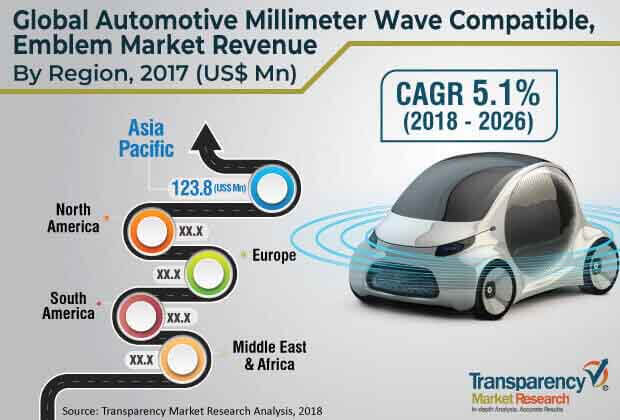
The global automotive millimeter wave compatible emblem market was valued at US$ 202.17 Mn in 2017 and is projected to expand at a compounded annual growth rate (CAGR) of over 5.1% from 2018 to 2026, according to a new report published by Transparency Market Research (TMR) titled ‘Automotive Millimeter Wave Compatible Emblem Market – Global Industry Analysis, Size, Share, Growth, Trends, and Forecast, 2018–2026.’ Growth of the market is primarily attributable to increasing sales of high-end and medium-range vehicles across the globe. Moreover, the shift of frequency range toward 77GHz and advantages associated with this frequency range have increased the use of millimeter wave radar systems in vehicles to further enhance driver safety. Rising use of safety systems in automobiles is expected to propel the global automotive millimeter wave compatible emblem market during the forecast period.

Request Brochure Of Report -  https://www.transparencymarketresearch.com/sample/sample.php?flag=B&rep_id=61050

The global automotive millimeter wave compatible emblem market has been segmented based on application and geography. In terms of application, the market has been divided into passenger and commercial. Based on geography, the market has been segmented into North America, Asia Pacific, Europe, Middle East & Africa, and South America. 

automotive millimeter wave compatible market

Request a Sample -  https://www.transparencymarketresearch.com/sample/sample.php?flag=S&rep_id=61050

Passenger Segment Expected to Hold a Major Share during the Forecast Period

Among applications, the passenger segment constituted a dominant market share in 2018. This is attributable to rise in the adoption of advanced driver assistance systems in high-end and medium-range vehicles in order to enhance the driver safety. Also, rising urbanization and raising standards of living of people lead to increase in the adoption of passenger vehicles, owing to the low travelling cost associated with them.  Prominent players operating in the global automobile industry are focusing on the production of a large number of passenger vehicles with advanced systems to improve safety and comfort. This would increase the deployment of automotive millimeter wave compatible emblems on high-end passenger car brands of Toyota Motor Corp, Skoda Auto, Mazda Motor Corporation, and Buick (General Motor Corp). The passenger segment of the global automotive millimeter wave compatible emblem market is projected to expand at a CAGR of 4.9% from 2018 to 2026. Furthermore, the commercial segment, especially of the market in North America and Europe, is expected to expand significantly during the latter half of the forecast period.

Asia Pacific Holds a Leading Market Share

In terms of geography, the global automotive millimeter wave compatible emblem market has been classified into North America, Europe, Asia Pacific, Middle East & Africa, and South America. Asia Pacific dominated the global automotive millimeter wave compatible emblem market in 2017, with Japan holding a major share of the market in the region, in terms of revenue. Toyoda Gosei Co, Ltd, a leading manufacturer of automotive millimeter wave compatible emblems based in Japan, generates a majority of its revenues from automobile manufacturers based in Asia Pacific. However, regulations imposed by the Federal Communications Commission (FCC) as well as governments in Europe regarding phase-out of the 24-GHz-frequency band and shift toward millimeter-wave frequencies are expected to make North America and Europe highly lucrative markets for millimeter wave compatible emblems during the forecast period.


Key players operating in the global automotive millimeter wave compatible emblem market are TOYODA GOSEI Co., Ltd, Shinko Nameplate Co., Ltd., ZANINI AUTO GRUP, S.A., Toyota Motor Corporation, Shimadzu Corporation, and ROHDE & SCHWARZ GmbH & Co. KG.

Global Sound Sensor Market Expected To Reach Us$ 2,192.7 Mn By 2026: Transparency Market Research

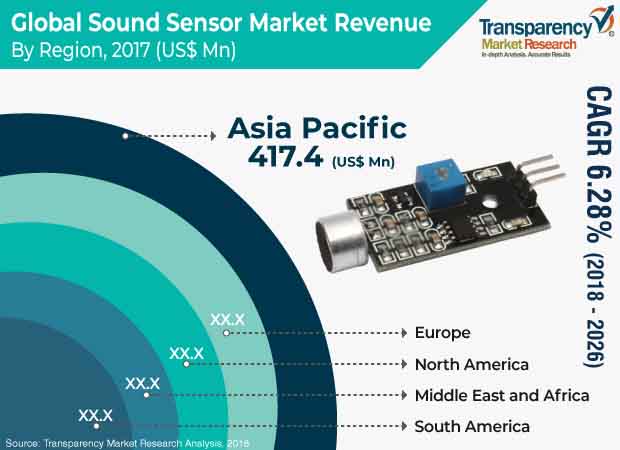
The global sound sensor market was valued at US$ 1,270.3 Mn in 2017 and is projected to register a compounded annual growth rate (CAGR) of over 6% from 2018 to 2026, according to a new report published by Transparency Market Research (TMR) titled ‘Sound Sensor Market – Global Industry Analysis, Size, Share, Growth, Trends, and Forecast, 2018–2026.’ The report suggests that rising significance of security and surveillance systems across the globe, increasing demand for voice recognition systems, and growing use of sound sensors in several medical applications are likely to augment the demand for sound sensors from 2018 to 2026. Since key players are introducing innovative sound sensors in developed markets such as North America, Europe, and Asia Pacific, these regions are likely to account for a leading share of the global sound sensor market during the forecast period. Rising investments in smartphone and automotive technologies and industrial automation across emerging markets such as China, Japan, South Korea, and India are likely to boost the sound sensor market in Asia Pacific from 2018 to 2026. 

sound sensor market

Request a Sample -  https://www.transparencymarketresearch.com/sample/sample.php?flag=S&rep_id=61047

Working limitations of sound sensor to hamper the sound sensor market

Sound sensors including ultrasound, acoustic, and audio sensors come with several advantages such as high sensitivity and ability to function across numerous industrial as well as medical applications. However, sound sensors have certain limitations as well. Ultrasound sensors cannot be used in vacuum, as sound waves require air as a medium for transmission. Moreover, these sensors may not function in any type of liquid medium. Thus, sound sensors need to be selected by considering all these limitations. Additionally, sensing ability of certain sound sensors is affected by soft edges of any surface as well as a certain level of temperature. These limitations of sound sensors are likely to hinder the global sound sensor market, with a medium-level impact, in the near future. 

Request Brochure Of Report -  https://www.transparencymarketresearch.com/sample/sample.php?flag=B&rep_id=61047]

Sound sensor is significantly adopted by the consumer electronics sector


In terms of application, the global sound sensor market has been segmented into health care, automotive, consumer electronics, security & surveillance, industrial, and others. The others segment comprises aerospace and chemical. In the consumer electronics industry vertical, sound sensors are used largely in smartphone devices for object detection, as a microphone, and as a fingerprint scanner. Technologically advanced, new-generation sound sensors i.e. ultrasonic sensors are replacing optical-proximity sensors, thereby improving the smartphone design. Several manufacturers are coming up with innovative ultrasonic sound sensors to be incorporated in a large number of smartphones. For instance, Qualcomm Incorporated, a semiconductor company, announced the launch of an innovative in-display fingerprint sensor in 2018. This sensor is based on the new 3D and ultrasonic sensor technology that uses sound waves to collect fingerprint data. Furthermore, the device is capable to read fingerprints contaminated by water or oil. 

Gigabit Passive Optical Network Chipset Market is Expected to Experience a Swift Development

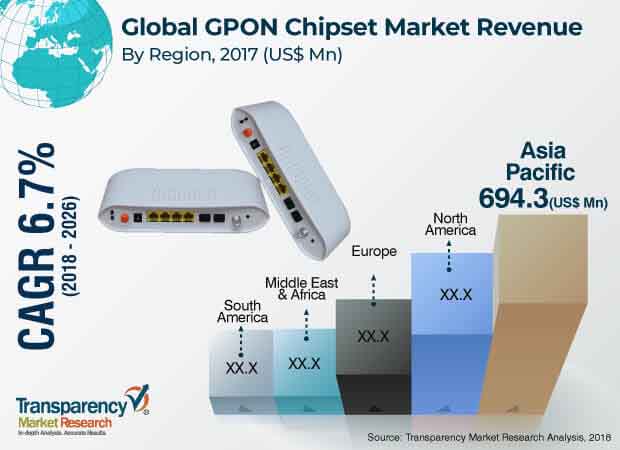
The global GPON chipset market was valued at US$ 1,751.2 Mn in 2017 and is projected to expand at a CAGR of over 6.7% from 2018 to 2026, according to a new report published by Transparency Market Research (TMR) titled ‘GPON Chipset Market – Global Industry Analysis, Size, Share, Growth, Trends, and Forecast, 2018–2026.’ Growth of the market is primarily attributable to advancements in technology and increasing need for secure and reliable network operations. Moreover, high demand for GPON chipsets across industries such as IT & telecom, residential, and hospitals is expected to propel the global GPON chipset market during the forecast period.

The global GPON chipset market has been segmented based on technology, equipment, end-use industry, and region. Based on technology, the market has been segregated into 2.5G-GPON, 10G-GPON, XGS-PON and NG-PON2. Based on equipment, the market has been classified into optical line termination (OLT), optical network unit (ONU), and optical distribution network (ODN). Based on end-use industry, the market has been divided into hospitals, residential, IT & telecom, government institutions, and others (including BFSI, transportation, and commercial). Based on geography, the global GPON chipset market has been segmented into North America, Asia Pacific, Europe, Middle East & Africa, and South America.

gigabit passive optical network gpon chipset market

Request a Sample -  https://www.transparencymarketresearch.com/sample/sample.php?flag=S&rep_id=59328

IT & Telecom segment expected to hold a prominent share

Among end-use industries, the IT & telecom segment is anticipated to constitute a significant market share from 2018 to 2026. The segment is expected to be driven by the rising demand for next-generation GPON chipsets. Increase in penetration of Internet across developing countries coupled with surge in IP traffic worldwide has fueled the market. Growing number of FTTH deployments and rising demand for higher bandwidths are expected to boost the demand for GPON chipsets during the forecast period.

Asia Pacific holds a leading market share
Among regions, Asia Pacific is anticipated to hold a leading share of the global market during the forecast period, followed by North America and Europe. This is primarily due to the rising demand for GPON in the Asia Pacific region, especially China. Over the last decade, there has been rapid conversion from wireless to wired optical communication in China. This transition phase is further driving the market in the region and making the country extremely favorable for penetration of GPON chipsets. Furthermore, presence of a large number of manufacturers of GPON chipsets in Asia Pacific has made it a prominent region of the global GPON chipset market. Moreover, growing adoption of gigabit passive optical networks (GPONs) and Ethernet passive optical networks (EPONs) is an increasing trend that the GPON chipset market is likely to witness in the next few years. Moreover, the market in Asia Pacific is projected to expand rapidly between 2018 and 2026, due to ongoing technological innovations in the region. The market in Middle East & Africa is estimated to witness moderate growth from 2018 to 2026. The market in South America is expected to witness sluggish growth during the forecast period.

Request Brochure Of Report - https://www.transparencymarketresearch.com/sample/sample.php?flag=B&rep_id=59328


The research study includes profiles of leading companies operating in the global GPON chipset market. Market players have been profiled in terms of attributes such as company overview, financial overview, business strategies, and recent developments. Parameters such as investments in and spending on GPON chipsets and developments by major market players have been tracked. Some of the key players operating in the global GPON chipset market are Adtran, Inc., Alphion Corporation, AT & T Inc., Broadcom Inc., Calix Inc., Cisco Systems, Dasan Zhone Solutions, Fujitsu Ltd., HiSilicon Technologies Co., Ltd., Huawei Technologies Co., Ltd., Marvell Technology Group, Motorola Solutions, NXP Semiconductors, Realtek Semiconductor Corporation, and Zyxel Communications Corp. 

Wednesday, March 4, 2020

Sheet Metal Fabrication Services Market is to be Worth US$ 4.4 Bn by 2026

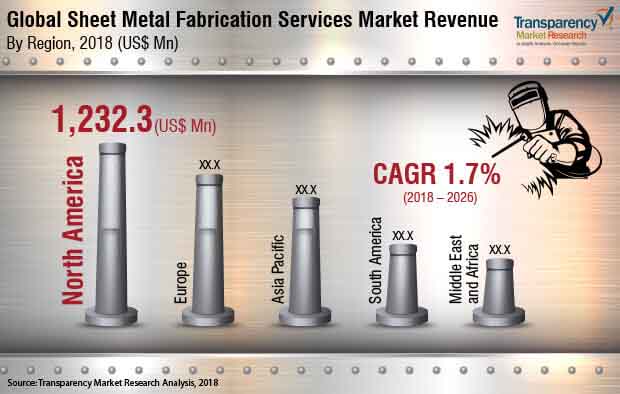
According to a new market report published by Transparency Market Research titled “Sheet Metal Fabrication Services Market – Global Industry Analysis, Size, Share, Growth, Trends, and Forecast, 2018 – 2026,” the global sheet metal fabrication services market is expected to reach US$ 4.4 Bn by 2026, expanding at a CAGR of 1.7% from 2018 to 2026. North America held the highest market share in the sheet metal fabrication services market in 2017.
The sheet metal fabrication services market is witnessing steady growth due to the increased demand from aerospace and aviation industries. Growth in the commercial airlines and defense aircrafts market will drive the sheet metal fabrication services market in the coming years. Demand for advanced technologies in the defense industry will create a favorable environment for the growth of this market in the near future.
global sheet metal fabrication services market
The low-interest rates and low fuel prices were identified as key factors that are responsible for the growth of the automotive market. The outlook for the automotive industry seems promising, with sales growing substantially, without any signs of slowing down. The number of leading automotive and manufacturing industries that employ sheet metal fabrication is growing year on year. Rising demand for iron and steel in the automobile industry has led to the growing significance of sheet metal fabricators. Sheet metal fabrication for the automotive industry typically involves superheating metals and quenching it inside the die itself, resulting in a high-strength metal part with various desirable properties. Advanced laser technology can enable the necessary cutting and trimming of these parts, which may be a big contributor to why this method is gaining popularity.
The sheet metal fabrication services industry is growing. The market is witnessing rise in deployment of CNC machine tools as one of the primary tools to undertake several applications such as shaping and molding. Advancements such as motion control software functions, high-speed smooth tool center point, jerk control, and AI contour control have greatly reduced the cycle time, along with cost reduction per part with augmented ergonomics, thereby increasing the demand for sheet metal fabricated products.
The sheet metal fabrication services market is growing and is highly competitive. Manufacturing, electronics, automobiles, and telecommunication are some of the major industries contributing to the growth of the market. Bending and punching of sheet metal is a common and vital process and has numerous applications which includes machine components, ductwork and industrial systems, architectural and structural components such as filters, panels, downspouts, and tank bodies.

tech