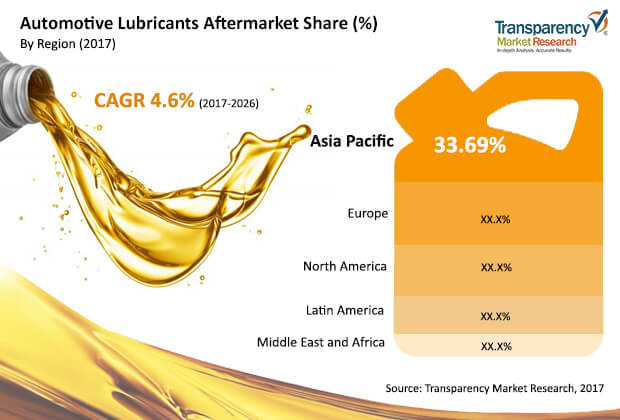
The global automotive lubricants aftermarket was valued around US $ 82 Bn in 2016 and is anticipated to expand at a CAGR of 4% from 2018 to 2026, according to a new report by Transparency Market Research (TMR) titled 'Automotive Lubricants Aftermarket - Global Industry Analysis, Size, Share, Growth, Trends, and Forecast, 2017–2026. ' Lubricant is a substance that is made up of base fluids and additives. A typical lubricant composition consist of 80% to 90% base oil and the rest is additives, However, this composition is subject to change as per the application. Lubricants are used for their ability to increase the operating lifespan of mechanical parts.They are used to minimize the friction between parts in contact with each other, thus eliminating wear and prolonging lifespan by Robust economies of countries such as China, India, Brazil, and Middle East have increased disposable income of the population, resulting in higher car ownership .This, in turn, has been increasing the consumption of automotive lubricants in recent times. Rise in demand for lightweight and high performance vehicles mandates the use of high-quality lubricants. This is a key factor propelling the consumption of automotive lubricants.
Request Sample PDF With Strategic Insights @ https://www.transparencymarketresearch.com/sample/sample.php?flag=S&rep_id=41672
Increasing Motorization Rate Coupled with Sales of New Vehicles and Established World Vehicle Fleet
Increase in demand for vehicles due to economic prosperity economy and increasing purchase power have resulted in higher car ownership. The global motorization rate ie vehicle ownership per 1000 inhabitants increased to 182 per thousand inhabitants in 2015 as against 178 in the previous year. Europe and North America are mature regions of the market for aftermarket automotive lubricants, with car ownership rates as high as 580 and 680 per thousand inhabitants in 2015. Low penetration of automotive vehicles, particularly in regions such as Latin America, Asia, and Middle East & Africa, presents significant opportunities for the automotive lubricants aftermarket. For instance, the motorization rate in Asia, Africa, and Latin America stood at 105, 42, and 176 per thousand inhabitants, respectively, in 2015. Along with this, accelerating economy, rapid urbanization, and increasing per capita income may compel individuals to own a vehicle. This, in turn, is expected to create an incremental market opportunity for the automotive lubricants aftermarket in the near future.
Longer Oil Drain Intervals May Dampen Market Expansion, but Increasing Penetration of Synthetic and Semi-synthetic Automotive Lubricants Offers Future Expansion Opportunity
Lubricant oil chemistry and engine technology have evolved tremendously in recent years, resulting in improved engine oil drain interval. During the 1950s, a truck engine oil change would have to be performed for every 500 miles. But those days are gone. Currently, it is possible to achieve an oil drain interval as high as 50,000 miles in heavy duty vehicles. Factors that have resulted in improved oil drain interval include cleaner fuels, higher quality lubricants, more dependable engines, and improved filter technology. The standard oil drain interval is 25,000 miles. However, various factors such as engine design, vehicle age, condition, driving patterns, and oil properties are known to affect the engine oil drain interval. Oil service intervals are pre-determined by engine manufacturers and are designed to provide optimum engine protection within intervals. Majority of the vehicle owner tends to follow these instructions, However, there has been growing trend of lengthening the oil service intervals beyond the OEM specifications. Extended oil drain intervals help fleet owners to reduce their operating and maintenance costs, mainly by keeping cars and trucks on road for longer. Improvement in engine oil drain interval is expected to decrease consumption of engine oils in commercial vehicles. This is anticipated to eventually decrease the consumption of lubricants during the forecast period and may dampen demand for aftermarket automotive lubricants. there has been growing trend of lengthening the oil service intervals beyond the OEM specifications. Extended oil drain intervals help fleet owners to reduce their operating and maintenance costs, mainly by keeping cars and trucks on road for longer. Improvement in engine oil drain interval is expected to decrease consumption of engine oils in commercial vehicles. This is anticipated to eventually decrease the consumption of lubricants during the forecast period and may dampen demand for aftermarket automotive lubricants. there has been growing trend of lengthening the oil service intervals beyond the OEM specifications. Extended oil drain intervals help fleet owners to reduce their operating and maintenance costs, mainly by keeping cars and trucks on road for longer. Improvement in engine oil drain interval is expected to decrease consumption of engine oils in commercial vehicles. This is anticipated to eventually decrease the consumption of lubricants during the forecast period and may dampen demand for aftermarket automotive lubricants.
A lubricant is a package consisting of base oil and certain additives to improve performance. Although, mineral-based automotive lubricants have been dominating the market due to their reasonable prices, there has been a shift toward the usage of synthetic and semi-synthetic based lubricants. As modern light weight vehicle engines are put under enormous stress, automakers worldwide are shifting toward less viscosity lubricant grades, which require synthetic base oils to meet mandated fuel economy standards and emission requirements. Demand for synthetic lubricants is high in North America and Western Europe. Europe is a prominent consumer of synthetic and semi-synthetic automotive lubricants in the aftermarket. In 2015, fully synthetic lubricants accounted for more than 10% of the market in Western Europe, with semi-synthetics accounting for market share of around 25%. Automakers across the globe are emphasizing on engine downsizing, which requires lower viscosity grade oils. This is likely to present further opportunities for synthetic lubricants over the forecast period.

No comments:
Post a Comment