Oral JAK Inhibitors Hold Promising Potential for Treatment of Alopecia Areata
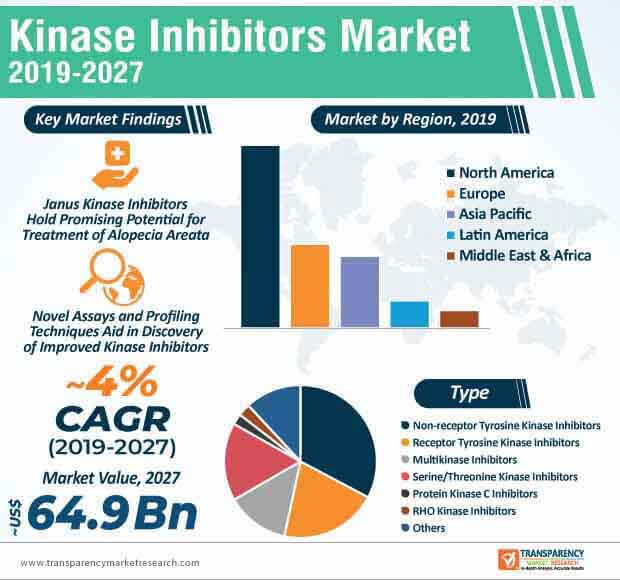
Kinase inhibitors are being highly publicized as a potential treatment for alopecia areata (AA). Janus kinase (JAK) inhibitors are being researched for the pathogenesis of alopecia areata, thus revealing that autoreactive cytotoxic T cells are important in the pathway that involves JAK.
Companies in the kinase inhibitors market are collaborating with researchers to carry out single-arm clinical trials, thus revealing the potential of oral JAK inhibitors as therapeutic agents for AA. Potential outcomes suggest that oral JAK inhibitors are effective and substantially tolerable to cases of moderate to severe AA. Researchers in the kinase inhibitors market are increasing efforts to conduct placebo?controlled clinical trials in order to confirm its efficacy and long-term safety.
Recent advancements are being made in anti-angiogenesis receptor tyrosine kinase inhibitors for the treatment of cancer. Angiogenesis is gaining the attention of healthcare companies to develop therapeutic targets for malignant tumors. Companies are achieving success by targeting angiogenesis in various carcinomas.
To know the scope of our report Get a Sample on Kinase Inhibitors Market
AI Accelerates Drug Discovery for Fibrosis Treatment through Molecular Modeling
The kinase inhibitors market is expected to expand at a modest CAGR of ~4% during the forecast period. However, innovations such as AI are transforming the market for kinase inhibitors. For instance, the U.S. biotechnology startup Insilico Medicine revealed its deep learning system that is capable of identifying potential treatments for fibrosis with the help of DDR1 (Discoidin Domain Receptor 1) kinase inhibitors.
AI is entering the kinase inhibitors market. Hence, companies should collaborate with biotechnology startups that are capable of integrating target identification with small molecule discovery through AI. Companies are increasing their efficacy in molecular modeling to accelerate drug discovery for fibrosis and other diseases.
Healthcare companies are capitalizing on generative adversarial networks (GANs) to generate novel molecular structures with specified properties. Likewise, deep learning is enabling companies with rapid identification of potent DDR1 kinase inhibitors. Thus, companies are improving their production capabilities to develop a novel drug pipeline of treatment of fibrosis with the help of AI.
Get a glimpse of the in-depth analysis through our Report Brochure
Biochemistry a Key Focus Point for Development of Novel Kinase Inhibitors
Novel assays and profiling techniques are helping companies to develop improved kinase inhibitors for drug development. Discovery of new kinase inhibitors is anticipated to improve biochemical, cellular, and in vivo assays that could offer new therapeutic targets. This is important since oncology is the focus of healthcare providers in the kinase inhibitors space, and research in this field of study is projected to grow exponentially.
Companies in the kinase inhibitors market are increasing R&D to gain expertise in cell signaling for the development of new drugs. The kinase inhibitors market is continuing to grow since the market is largely consolidated with major players accounting to ~68% of the market share. However, developing novel kinase inhibitors poses as a challenge for manufacturers. Hence, manufacturers are collaborating with researchers to acquire a decision-based understanding of kinase biology, cell signaling, and its outcome in various diseases. They are increasing efforts to gain information on biochemical and biophysical assays to examine the potency and selectivity of kinase inhibitors.
Companies Expand Product Portfolio of Tyrosine Kinase Inhibitors for Treatment of Rheumatoid Arthritis
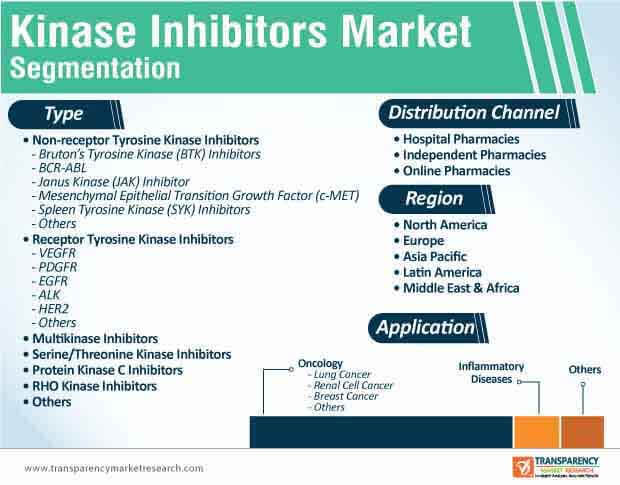
Tyrosine kinase inhibitors are being increasingly used for the treatment of autoimmune and inflammatory skin diseases. This is evident since inflammatory diseases application segment is estimated to account for a significant share of the kinase inhibitors market. The global kinase inhibitors market is estimated to reach a value of ~US$ 64.9 Bn by the end of 2027. Owing to excellent multiple signaling processes and disease pathogenesis of tyrosine kinase inhibitors, companies are tapping into incremental opportunities, since these inhibitors serve as novel therapeutic agents for inflammatory and other diseases.
Small molecule tyrosine kinase inhibitors are capable of acquiring pharmacological control in malignant processes, and autoimmune and immune-mediated diseases. Companies in the kinase inhibitors market are expanding their product portfolio in tyrosine kinase inhibitors for the treatment of rheumatoid arthritis. They are increasing efforts to gain approval from health commissions for JAK inhibitors, owing to their effectiveness in the treatment of rheumatoid arthritis.
Expanding operations in future? To get the perfect launch ask for a custom report
More Trending Reports by Transparency Market Research – https://www.biospace.com/article/crispr-and-cas-genes-market-to-expand-at-fast-pace-thanks-to-rise-in-research-and-development-activities-tmr/

No comments:
Post a Comment